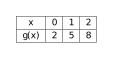
Function \(f\) is given by \(f(x)=4x+1\). Function \(g\) is given by the table: \(g(0)=2,\ g(1)=5,\ g(2)=8\). Which function has the greater rate of change?
- \(f(x)\)
- \(g(x)\)
- Both are equal
- Cannot be determined


Learn to reason about and solve Grade 8 problems involving Comparing Two Functions.
Function \(f\) is given by \(f(x)=4x+1\). Function \(g\) is given by the table: \(g(0)=2,\ g(1)=5,\ g(2)=8\). Which function has the greater rate of change?
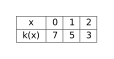
Function \(h(x)=-2x+7\) and function \(k\) shown in the table: \((0,7)\), \((1,5)\), \((2,3)\). Which statement is true?
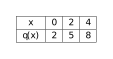
Function \(p(x)=\frac{3}{2}x-4\) and the table for function \(q\): \((0,2)\), \((2,5)\), \((4,8)\). Which has a steeper slope?
Plan A costs \($15\) per month: \(A(m)=15+0.10m\). Plan B shown in table: \((0,$20)\), \((100,$25)\), \((200,$30)\), \((300,$35)\). Which plan has the higher base cost?
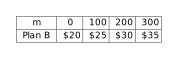
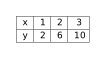
Table: \((1,2)\), \((2,6)\), \((3,10)\); and \(z(x)=3x+1\). Which crosses the \(y\)-axis higher?
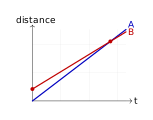
Function \(A(t)=60t\) (mph). Function \(B\) passes through \((0,1)\) and \((5,5)\) (on distance-time graph, with \(t\) in hours). Which travels faster?
\(S(m)=500+25m\) and table \((0,$600)\), \((3,$675)\), \((6,$750)\). Which starts with more money?
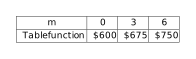
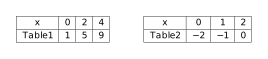
Table 1: \((0,1)\), \((2,5)\), \((4,9)\). Table 2: \((0,-2)\), \((1,-1)\), \((2,0)\). Which table represents a function with steeper rate of change?
The slope of \(f\) is \(4\). For \(g\): \(\Delta y/\Delta x=3/1=3\). Since \(4>3\), \(f\) has the greater rate of change.
Slope of \(h\): \(-2\). From \(k\)'s table: \((5-7)/(1-0)=-2\). Both have slope \(-2\).
Slope of \(p\): \(\frac{3}{2}=1.5\). From table \(q\): \((5-2)/(2-0)=3/2=1.5\). Both have slope \(1.5\).
Plan A base cost: \($15\). Plan B at \(m=0\): \($20\). Since \(20>15\), Plan B is higher.
Table slope: \((6-2)/(2-1)=4\). From \((1,2)\): \(2=4(1)+b \Rightarrow b=-2\). So \(y\)-intercept is \(-2\). For \(z\): \(y\)-intercept is \(1\). Since \(1>-2\), \(z\) is higher.
Speed is the slope. \(A\) has slope \(60\) mph. \(B\) has slope \((5-1)/(5-0)=4/5=0.8\) mph. Since \(60>0.8\), \(A\) travels faster.
\(S(0)=500\). Table shows \(600\) at \(m=0\). Since \(600>500\), table function starts higher.
Rate for Table 1: \((5-1)/(2-0)=2\). Rate for Table 2: \((-1-(-2))/(1-0)=1\). Since \(2>1\), Table 1 is steeper.
