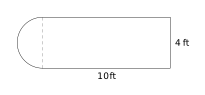
A composite figure is a rectangle (\(10\) ft by \(4\) ft) with a semicircle attached on one end (diameter \(4\) ft). What is the total area? Use \(\pi\approx3.14\).
- \(40\) ft\(^2\)
- \(46.28\) ft\(^2\)
- \(52.56\) ft\(^2\)
- \(58.84\) ft\(^2\)
Learn to reason about and solve Grade 8 problems involving Composite Figures: Area and Perimeter.
A composite figure is a rectangle (\(10\) ft by \(4\) ft) with a semicircle attached on one end (diameter \(4\) ft). What is the total area? Use \(\pi\approx3.14\).
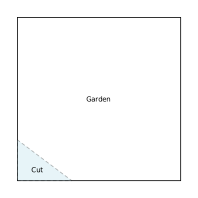
A garden has the shape of a square with side length \(12\) m with a triangular corner cut out (base \(4\) m, height \(3\) m). What is the remaining area of the garden?
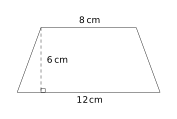
A trapezoid has parallel sides of \(8\) cm and \(12\) cm with a height of \(6\) cm. This trapezoid is part of a composite figure. What is its area?
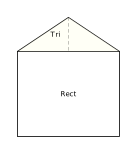
A composite figure consists of a rectangle (\(6\) m by \(5\) m) with a triangle on top (base \(6\) m, height \(2\) m). Find the total area.
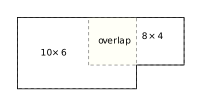
A floor plan is an L-shaped figure made of two rectangles: one is \(10\) ft by \(6\) ft, the other is \(8\) ft by \(4\) ft. The rectangles overlap in a \(4\) ft by \(4\) ft region. What is the total floor area?
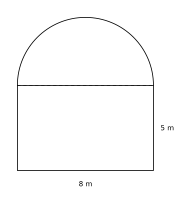
A semicircle is mounted on top of a rectangle. The rectangle has dimensions \(8\) m by \(5\) m, and the semicircle has diameter \(8\) m. Find the total perimeter (outline only).
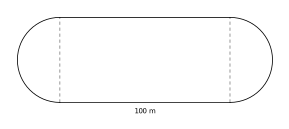
A running track is composed of a rectangle (\(100\) m by \(50\) m) with two semicircles on the short ends (diameter \(50\) m each). Find the total perimeter of the track.
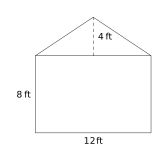
A composite figure consists of a rectangle with a triangular roof. The rectangle is \(12\) ft wide and \(8\) ft tall, and the triangle has the same base and a height of \(4\) ft. What is the area?
Decompose: rectangle and semicircle. Rectangle area \(=10\times4=40\) ft\(^2\). Semicircle has diameter \(4\) ft, so radius \(r=2\) ft. Semicircle area \(=\frac{1}{2}\pi r^2=\frac{1}{2}\times3.14\times2^2=6.28\) ft\(^2\). Total \(=40+6.28=46.28\) ft\(^2\).
Square area \(=12\times12=144\) m\(^2\). Triangle area \(=\frac{1}{2}\times4\times3=6\) m\(^2\). Remaining area \(=144-6=138\) m\(^2\). Option D traps those who skip subtraction; option C comes from minor arithmetic error.
Trapezoid area \(=\frac{1}{2}(b_1+b_2)\times h=\frac{1}{2}(8+12)\times6=\frac{1}{2}\times20\times6=60\) cm\(^2\).
Rectangle area \(=6\times5=30\) m\(^2\). Triangle area \(=\frac{1}{2}\times6\times2=6\) m\(^2\). Total \(=30+6=36\) m\(^2\).
Decompose using addition and subtraction. First rectangle \(=10\times6=60\) ft\(^2\). Second rectangle \(=8\times4=32\) ft\(^2\). The overlap region is \(4\times4=16\) ft\(^2\) and must be subtracted to avoid double-counting. Total \(=60+32-16=76\) ft\(^2\).
Perimeter \(=8+5+5+\pi\times4=18+12.56=30.56\) m. The top edge is not counted because the semicircle is attached there.
Decompose the perimeter: two long sides of rectangle plus two semicircles (which form one complete circle). Long sides: \(100+100=200\) m. Circle circumference: \(\pi d=3.14\times50\approx157\) m. Total \(=200+157=357\) m.
Decompose: rectangle plus triangular roof. Rectangle area \(=12\times8=96\) ft\(^2\). Triangle area \(=\frac{1}{2}\times12\times4=24\) ft\(^2\). Total area \(=96+24=120\) ft\(^2\).