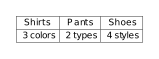
A student can wear a shirt, pants, and shoes. There are \(3\) shirt colors, \(2\) pant types, and \(4\) shoe styles. How many different outfits are possible?
- \(3 + 2 + 4 = 9\)
- \(3 \times 2 \times 4 = 24\)
- \(3^2 \times 4 = 36\)
- \(24 + 3 = 27\)
Learn to reason about and solve Grade 8 problems involving Counting Principle and Permutations.
A student can wear a shirt, pants, and shoes. There are \(3\) shirt colors, \(2\) pant types, and \(4\) shoe styles. How many different outfits are possible?
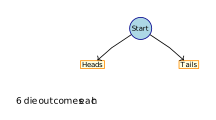
A probability experiment involves flipping a coin (heads or tails) and rolling a die (1 through 6). How many different outcomes are possible?
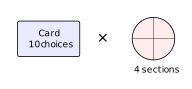
A game requires picking a card from a deck of 10 cards and then spinning a spinner with 4 sections. How many possible results are there?
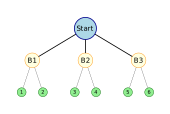
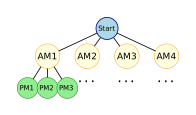
A tree diagram shows that a choice has 3 branches first, then each branch splits into 2 more branches. How many final outcomes are there?
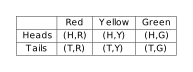
In a game, you spin a spinner with 3 colors (red, yellow, green) and flip a coin (heads, tails). The table shows all outcomes. How many outcomes are there?
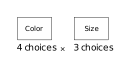
A store sells T-shirts in 4 colors and 3 sizes. The diagram shows one color choice and one size choice. How many different T-shirt options are there?
A student chooses a morning task (4 options) and an afternoon task (3 options). A partial tree diagram is drawn. How many final outcome branches are there?
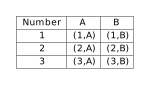
A game involves picking a number (1, 2, or 3) and a letter (A or B). The table lists some outcomes. How many total outcomes should the complete table show?
Multiply the number of choices at each step: \(3 \times 2 \times 4 = 24\) different outfits.
Coin flip (2 outcomes) combined with die roll (6 outcomes): \(2 \times 6 = 12\) total outcomes.
Card pick (10 choices) times spinner section (4 choices): \(10 \times 4 = 40\) possible results.
Each of the 3 initial branches splits into 2 outcomes: \(3 \times 2 = 6\) final outcomes.
From the table, count all cells: \(3\) colors times \(2\) coin outcomes \(= 6\) total outcomes.
Each of the 4 colors can pair with each of the 3 sizes: \(4 \times 3 = 12\) total options.
Each of the 4 morning branches splits into 3 afternoon branches: \(4 \times 3 = 12\) final outcomes.
Count the cells in the table: \(3\) numbers \(\times\) \(2\) letters \(= 6\) total outcomes, shown as rows and columns.