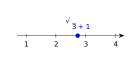
On a number line, where would \(\sqrt{3}+1\) fall?
- Between \(1\) and \(2\)
- Greater than \(4\)
- Between \(3\) and \(4\)
- Between \(2\) and \(3\)


Learn to reason about and solve Grade 8 problems involving Estimating Expressions with Irrational Numbers.
On a number line, where would \(\sqrt{3}+1\) fall?
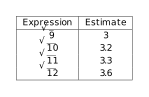
Which estimate has the largest error (furthest from the true value)?
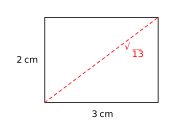
A rectangle has dimensions \(2\) cm by \(3\) cm. The diagonal is \(\sqrt{13}\) cm. What is the best estimate of the diagonal?
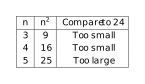
Between which two consecutive integers does \(\sqrt{24}\) fall?
Which is the best estimate of \(\pi+\sqrt{10}\)?
Which is the best estimate of \(\sqrt{26}\)?
Which is the best estimate of \(\sqrt{2}\)?
Which is the best estimate of \(\pi\)?
\(\sqrt{3}\approx1.73\), so \(\sqrt{3}+1\approx2.73\), which falls between \(2\) and \(3\). Distractors A, C, and D represent underestimation, overestimation, and far overestimation of \(\sqrt{3}\).
\(\sqrt{9}=3\) (exact), \(\sqrt{10}\approx3.162\) (error 0.04), \(\sqrt{11}\approx3.317\) (error 0.02), \(\sqrt{12}\approx3.464\) (error 0.14). Option D has error of 0.14, much larger than others.
By the Pythagorean theorem, diagonal \(= \sqrt{2^2 + 3^2} = \sqrt{4 + 9} = \sqrt{13} \approx 3.606 \approx 3.6\) cm.
\(4^2 = 16\) and \(5^2 = 25\). Since \(16 < 24 < 25\), we have \(4 < \sqrt{24} < 5\). More precisely, \(\sqrt{24} \approx 4.90\).
Using \(\pi\approx3.14\) and \(\sqrt{10}\approx3.16\) (since \(3.16^2\approx9.99\)), the sum is approximately \(6.30\).
Since \(5^2=25\) and \(5.1^2=26.01\approx26\), we have \(\sqrt{26}\approx5.1\). Distractors: 5.0 (close but low), 4.5 and 6.0 (too far).
Since \(1.4^2=1.96\approx2\) and \(1.5^2=2.25\), we have \(\sqrt{2}\approx1.41\).
\(\pi\approx3.14159\ldots\), commonly estimated as \(3.14\) or \(3.2\) for Grade 8 work. Distractors: A (underestimate), B (rounds down), D (rounds up).
