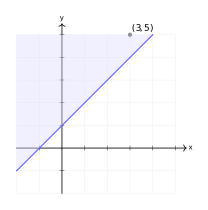
The graph shows a solid line and shading above. The point \((3,5)\) is marked in the shaded region. Which inequality is represented?
- \(y > x + 1\)
- \(y \geq x + 1\)
- \(y < x + 1\)
- \(y \leq x + 1\)


Learn to reason about and solve Grade 8 problems involving Graphing Linear Inequalities in Two Variables.
The graph shows a solid line and shading above. The point \((3,5)\) is marked in the shaded region. Which inequality is represented?
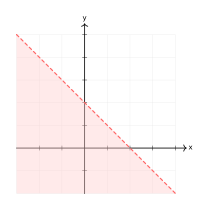
Based on the dashed line and shaded region, what inequality is shown?
Graph \(y \geq \frac{1}{2}x\). Which region should be shaded?
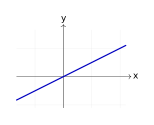
The graph shows which inequality?
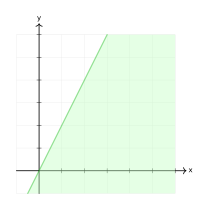
What inequality matches this graph?
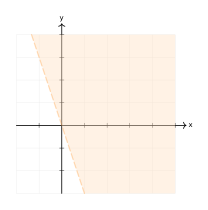
Which inequality is represented?
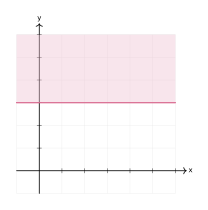
The graph shows which inequality?
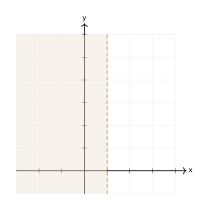
Which inequality matches the graph?
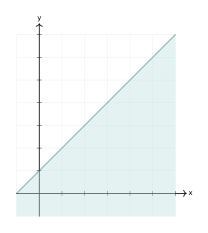
The solid line (boundary included) with shading ABOVE indicates \(y \geq x + 1\). Verify: \((3,5)\) gives \(5 \geq 3+1=4\) ✓ TRUE.
DASHED line means \(>\) or \(<\). Shading BELOW means \(y <\). Combined: \(y < -x + 2\).
The inequality \(\geq\) means "greater than or equal," so shade ABOVE the line. The SOLID line is included in the solution.
SOLID line (includes boundary) and shading BELOW the line indicates \(y \leq 2x\).
The DASHED line and shading ABOVE indicate a strict inequality with \(y\) greater: \(y > -3x\).
Solid horizontal line at \(y = 3\) with shading ABOVE means \(y \geq 3\).
Dashed vertical line at \(x = 1\) with shading to the LEFT means \(x < 1\).
SOLID line (includes boundary) and shading BELOW indicate \(y \leq x + 1\).
