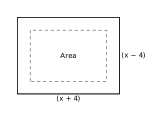
The area of a rectangle with dimensions \((x+4)\) and \((x-4)\) is shown below. Which expression represents the area?
- \(x^2-8\)
- \(x^2+8x-16\)
- \(x^2-16\)
- \(2x-16\)


Learn to reason about and solve Grade 8 problems involving Multiplying Binomials and Factoring Quadratics.
The area of a rectangle with dimensions \((x+4)\) and \((x-4)\) is shown below. Which expression represents the area?
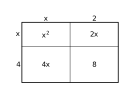
The area model below represents \((x+2)(x+4)\): What is the total area?
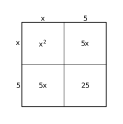
The area model represents \((x+5)^2\): What is the sum of all areas?
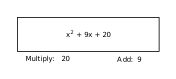
A clue box for factoring the trinomial shows: Which expression completes the factorization?
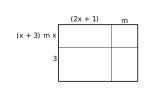
A garden is shaped like a rectangle with length \((2x+1)\) m and width \((x+3)\) m. What is its area in square meters?
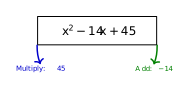
Factor \(x^2-14x+45\).
Factor \(9x^2-36\) completely.

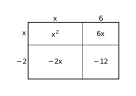
An area model for \((x+6)(x-2)\) shows four rectangular regions. What is their total area?
Difference of squares: \((x+4)(x-4)=x^2-4^2=x^2-16\).
Sum of areas: \(x^2+2x+4x+8=x^2+6x+8\).
Sum: \(x^2+5x+5x+25=x^2+10x+25=(x+5)^2\).
Trinomial \(x^2+9x+20\) factors as \((x+4)(x+5)\) (multiply: \(4 \cdot 5=20\), add: \(4+5=9\)).
Area = \((2x+1)(x+3)=2x^2+6x+x+3=2x^2+7x+3\) m\(^2\).
Find two numbers that multiply to \(45\) and add to \(-14\): \(-5\) and \(-9\). Verify: \((-5)(-9)=45\) and \(-5-9=-14\).
Factor out GCF of \(9\): \(9(x^2-4)\). Then difference of squares: \(9(x-2)(x+2)\).
Sum of regions: \(x^2+6x-2x-12=x^2+4x-12\).
