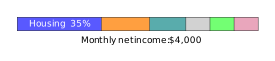
A household budget for monthly net income of $4{,}000 is divided as follows: Housing 35%, Food 20%, Transportation 15%, Utilities 10%, Savings 10%, Other 10%. How much is allocated to housing?
- $400
- $800
- $1{,}400
- $2{,}000
Learn to reason about and solve Grade 8 problems involving Personal Financial Literacy.
A household budget for monthly net income of $4{,}000 is divided as follows: Housing 35%, Food 20%, Transportation 15%, Utilities 10%, Savings 10%, Other 10%. How much is allocated to housing?
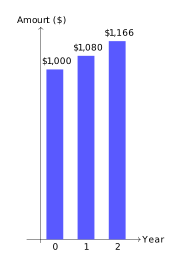
An investment grows with compound interest. If $1{,}000 is invested at 8% compound interest annually, which is the closest to the amount after 2 years?
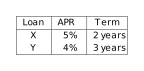
A person compares two loans for $2{,}000: If the person wants to minimize total borrowing cost, which loan is better?
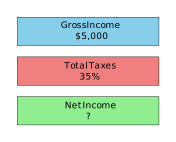
A freelancer's gross income is $5{,}000/month. After federal tax (15%), state tax (5%), and self-employment tax (15%), what is the net income?
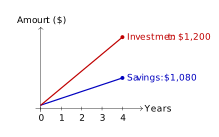
A student invests $1{,}000 and compares: saving account at 2% simple interest vs investing at 5% simple interest for 4 years. What is the difference in final amounts?
Marco deposits $1{,}500 at an annual simple-interest rate of 4%. How much interest does he earn after 2 years?
Sarah invests $2{,}000 at 5% simple interest for 3 years. At the end of 3 years, she decides whether to withdraw all her money or let it grow another 3 years at the same rate. Which statement correctly predicts the impact of waiting another 3 years?
A bank offers 6% simple interest. If you deposit $5{,}000 for 18 months, how much interest will you earn?
Housing allocation = 35% of $4{,}000 = \(0.35\times4000=$1{,}400\).
\(A=1000(1.08)^2=1000\times1.1664=$1{,}166.40\approx$1{,}166\).
Loan X costs $200 in interest; Loan Y costs $240. Loan X is cheaper overall.
Total tax rate: \(15\% + 5\% + 15\% = 35\%\). Net income: $5{,}000 \(\times\) (1 \(-\) 0.35) = $5{,}000 \(\times\) 0.65 = $3{,}250.
Savings account: \(A=1000(1+0.02\times4)=$1{,}080\). Investment: \(A=1000(1+0.05\times4)=$1{,}200\). Difference: $1{,}200 \(-\) $1{,}080 = $120.
Simple interest: \(I=Prt=1500\times0.04\times2=$120\). Distractor A is 1-year interest; C is double (wrong time calc); D confuses principal.
After 3 years: \(A=2000+2000\times0.05\times3=$2{,}300\). Another 3 years of simple interest on $2{,}000: \(I=2000\times0.05\times3=$300\). Total: $2{,}300 + $300 = $2{,}600. (Note: Simple interest, not compound, means the same principal earns the same amount each 3-year period.)
\(18\) months \(=1.5\) years. \(I=5000\times0.06\times1.5=$450\).