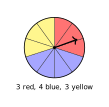
A spinner has 10 equal sections: 3 red, 4 blue, and 3 yellow. What is the probability of landing on red OR blue?
- \(\frac{4}{10}\)
- \(\frac{12}{10}\)
- \(\frac{7}{10}\)
- \(\frac{3}{10}\)


Learn to reason about and solve Grade 8 problems involving Probability of Simple and Compound Events.
A spinner has 10 equal sections: 3 red, 4 blue, and 3 yellow. What is the probability of landing on red OR blue?
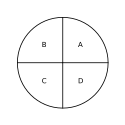
The spinner above is divided into 4 equal sections labeled A, B, C, and D. What is the probability of landing on section A?
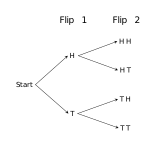
A tree diagram shows all possible outcomes when a coin is flipped twice. According to the diagram, how many total outcomes are there?
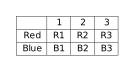
The table above shows all possible outcomes when selecting a color and a number. How many total outcomes are there?
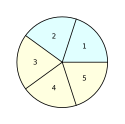
A spinner has 5 equal sections numbered 1--5. Two sections (1 and 2) are shaded. If you spin once, what is the probability of landing on a shaded section?
A coin is flipped and a spinner labeled 1, 2 is spun. What is the probability of getting an outcome where the coin is heads?

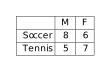
The table shows the number of boys (M) and girls (F) who play soccer and tennis. If one student is selected at random, what is the probability that they play tennis?
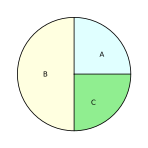
The spinner is divided into three sections. Section A covers 90°, section B covers 180°, and section C covers 90°. What is the probability of landing on section B?
\(P(\text{red or blue}) = P(\text{red}) + P(\text{blue}) = \frac{3}{10} + \frac{4}{10} = \frac{7}{10}\).
Each section is equal, so each has probability \(\frac{1}{4}\).
The tree diagram shows 4 final branches, one for each outcome: HH, HT, TH, TT.
The table shows \(2 \times 3 = 6\) outcomes total.
Two of the five sections are shaded, so \(P(\text{shaded}) = \frac{2}{5}\).
Outcomes with H: H1, H2. That's 2 of 4 outcomes. \(P = \frac{2}{4} = \frac{1}{2}\).
Total: 8 + 6 + 5 + 7 = 26. Tennis: 5 + 7 = 12. \(P(\text{tennis}) = \frac{12}{26}\).
Total: 360°. Section B: 180°. So \(P(B) = \frac{180}{360} = \frac{1}{2}\).
