Which pair of expressions is equivalent?
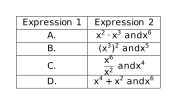
- Option A
- Option B
- Option C
- Option D


Learn to reason about and solve Grade 8 problems involving Properties of Integer Exponents.
Which pair of expressions is equivalent?
Which expression is equivalent to \(\frac{5^6}{5^2}\)?
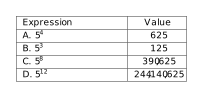
Look at the table. Which expression is not equivalent to \(x^6\)?
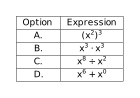
Match the expression to the exponent law it uses: Which expression uses the quotient rule?
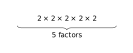
Visual: Expanded form. \(2^5\) means: If we multiply \(2^3 \times 2^4\), how many total factors of 2 do we have?
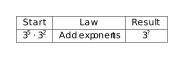
Complete the table by applying exponent laws: What is the exponent in the result?
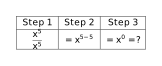
Using the quotient rule, explain why \(x^0 = 1\) (for \(x \neq 0\)). Since \(\frac{x^5}{x^5} = 1\), what must \(x^0\) equal?
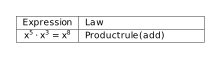
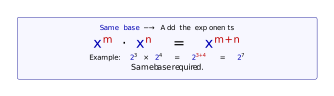
Which law does this diagram represent? Which of the following uses this same law?
Check each: (A) \(x^5 \neq x^6\); (B) \(x^6 \neq x^5\); (C) \(x^4 = x^4\) ✓; (D) addition, not a law.
\(\frac{5^6}{5^2} = 5^{6-2} = 5^4 = 625\).
(D) is \(x^6 + 1\), not \(x^6\), because addition is not an exponent law.
Quotient rule subtracts exponents: \(\frac{m^9}{m^3} = m^{9-3} = m^6\). (A) is product, (B) is power of power, (C) is power of product.
\(2^3\) has 3 factors, \(2^4\) has 4 factors. Total: \(3 + 4 = 7\) factors. This illustrates the product rule: \(2^3 \times 2^4 = 2^7\).
Product rule: \(3^5 \cdot 3^2 = 3^{5+2} = 3^7\).
The quotient rule shows: \(\frac{x^5}{x^5} = x^{5-5} = x^0\). Since \(\frac{x^5}{x^5} = 1\), we have \(x^0 = 1\).
The diagram shows the product rule (add exponents). (C) uses it: \(2^{4+5} = 2^9\). (A) is power of product, (B) is quotient rule, (D) is power of power.
