Based on the number line, which statement is true?
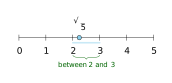
- \(\sqrt{5}\) is rational
- \(\sqrt{5}\) is between \(1\) and \(2\)
- \(\sqrt{5} = 2.5\)
- \(\sqrt{5} \approx 2.24\)


Learn to reason about and solve Grade 8 problems involving Rational and Irrational Numbers.
Based on the number line, which statement is true?
Which statement is true?
Which decimal is rational?
Which number should be plotted as irrational (height 0)?
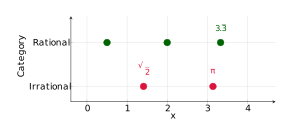
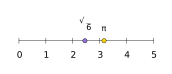
Which is true based on the number line?
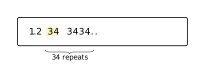
The decimal \(1.2\overline{34}\) (where \(34\) repeats) is:
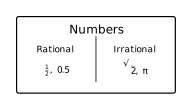
Which number should be placed in the Rational section?
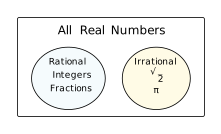
Which statement is true?
The number line shows \(\sqrt{5}\) positioned between \(2\) and \(3\), closer to \(2.2\). Since \(2.2^2 = 4.84\) and \(2.24^2 \approx 5.02\), we have \(\sqrt{5} \approx 2.24\). Also, \(\sqrt{5}\) is irrational.
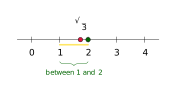
From the number line, \(\sqrt{3} \approx 1.73\) is positioned to the left of \(2\), so \(\sqrt{3} < 2\). We can verify: \(1.73^2 = 2.9929 < 4 = 2^2\). Also, \(\sqrt{3}\) is irrational.
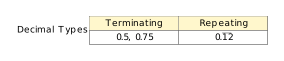
The repeating decimal \(0.454545\ldots = 0.\overline{45} = \frac{45}{99} = \frac{5}{11}\), which is rational. Non-repeating non-terminating decimals like \(\pi\) and \(e\) are irrational.
Only \(\sqrt{5}\) is irrational (a square root of a non-perfect square). The others are rational: \(0.5 = \frac{1}{2}\), \(2\) is an integer, and \(3.\overline{3} = \frac{10}{3}\).
From the number line, \(\sqrt{6} \approx 2.45\) is to the left of \(\pi \approx 3.14\). Therefore \(\sqrt{6} < \pi\). Both are irrational.
Any decimal that eventually repeats is rational. In fact, \(1.2\overline{34} = 1.2343434\ldots = \frac{611}{495}\), so it can be written exactly as a fraction.
Only \(-\frac{9}{2}\) is rational (a fraction of two integers). The others are irrational: \(\sqrt{13}\) is a non-perfect-square root, \(2 + \sqrt{5}\) is a sum involving an irrational, and \(\sqrt{\pi}\) is the root of an irrational.
Any integer \(n\) can be written as \(\frac{n}{1}\), so every integer is rational. Choice A is false because square roots of perfect squares, such as \(\sqrt{25}\), are rational. Choice C is false because repeating decimals are always rational. Choice D is false because numbers that can be written as a fraction are rational, not irrational.
