Looking at the two rectangles, which transformation was applied?
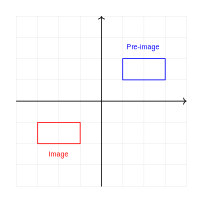
- Reflection across the \(x\)-axis
- Reflection across the \(y\)-axis
- 180° rotation about the origin
- Dilation by scale factor \(2\)


Learn to reason about and solve Grade 8 problems involving Rotations, Reflections, and Translations.
Choose a free PDF. Each has different questions and worked solutions. The preview shows the student question page; open the PDF to read or print it at full size.
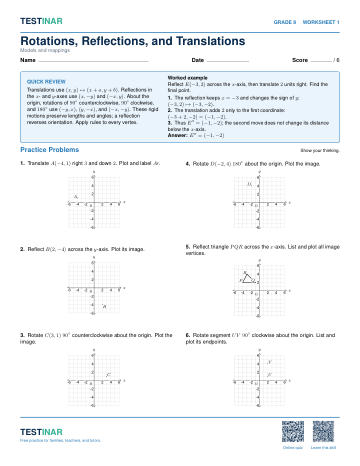 Worksheet 1
6 problems
Models and mappings.
Open PDF
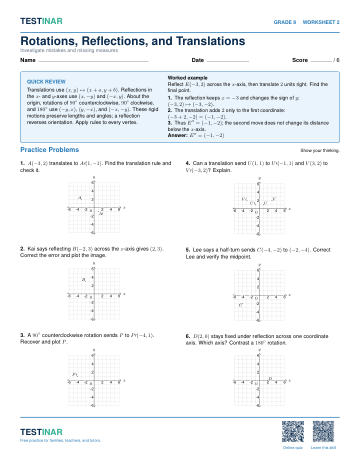 Worksheet 2
6 problems
Investigate mistakes and missing measures.
Open PDF
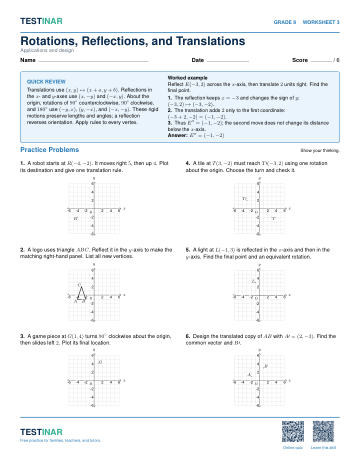 Worksheet 3
6 problems
Applications and design.
Open PDF
Print page 1 for students. Page 2 has the solutions; page 3 has optional book recommendations.
These online questions are separate from the three PDF worksheets above.
Looking at the two rectangles, which transformation was applied?
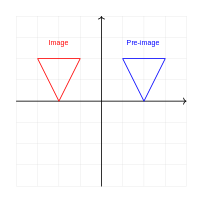
The triangle was reflected across which line?
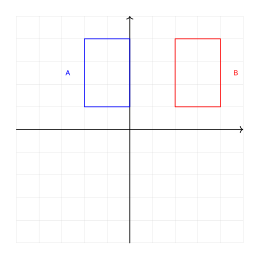
The figure shows shape A and shape B. Which single transformation maps A to B?
Which sequence of transformations was applied?
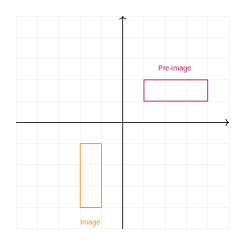
The blue rectangle is transformed to the dashed red rectangle. Which line of reflection was used?
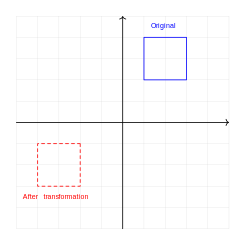
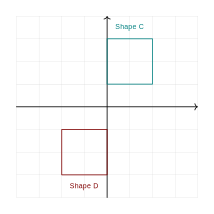
If Shape C is rotated 180° about the origin, which shape results?
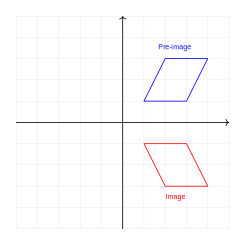
The figure shows a transformation. If this is a reflection across the \(x\)-axis, which vertex of the pre-image corresponds to the vertex at \((3,-1)\) in the image?
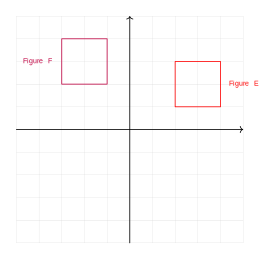
Figures E and F are congruent. If Figure E was transformed to Figure F, which transformation(s) could have been applied?
A 180° rotation about the origin maps \((x, y) \to (-x, -y)\). The pre-image at \((1,1)\) maps to \((-1,-1)\) in the image, confirming the rotation.
Reflecting across the \(y\)-axis changes \((x, y) \to (-x, y)\). The pre-image vertex \((3,2) \to (-3,2)\) and apex \((2,0) \to (-2,0)\), matching the image.
Shape A has a corner at \((-2, 1)\) and shape B has a corresponding corner at \((2, 1)\). The horizontal shift is \(2 - (-2) = 4\) units.
A 90° counterclockwise rotation sends the rectangle to a vertical position. Translating that rotated image 5 units down matches the orange image.
Reflection across \(y = -x\) maps \((x,y) \to (-y, -x)\). The point \((1,2)\) maps to \((-2, -1)\) in the image.
A 180° rotation about the origin takes a point in Quadrant I to Quadrant III. Shape C's corner at \((2,3)\) maps to \((-2,-3)\), matching Shape D.
Reflection across the \(x\)-axis uses \((x, y) \to (x, -y)\). The point \((3,1)\) reflects to \((3,-1)\).
Figure E and Figure F have the same size and orientation. Each point moves 5 units left and 1 unit up (translation), not a rotation which would change orientation.
