Testinar Grade 8 math

Slope and the Equations of a Line

Learn to reason about and solve Grade 8 problems involving Slope and the Equations of a Line.

CH03-03 Equations, Inequalities, and Systems
Name
Date
Score
____ / 8
Directions Solve each problem. Show your reasoning on the page or on separate paper. Check the answer key only after finishing.
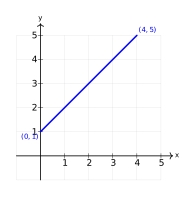
  1. What is the slope of the line shown in the graph?
    Slope and the Equations of a Line visual for G8-C03-T03-Q012
    1. \(1\)
    2. \(2\)
    3. \(\frac{1}{2}\)
    4. \(4\)
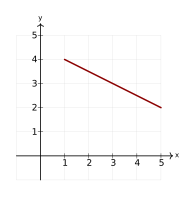
  2. What is the equation of the line shown?
    Slope and the Equations of a Line visual for G8-C03-T03-Q013
    1. \(y=-\frac{1}{2}x+\frac{9}{2}\)
    2. \(y=2x+2\)
    3. \(y=-2x+6\)
    4. \(y=\frac{1}{2}x+3\)
  3. The table shows the relationship between \(x\) and \(y\) on a line. What is the slope?

    Slope and the Equations of a Line visual for G8-C03-T03-Q014
    1. \(2\)
    2. \(11\)
    3. \(\frac{1}{3}\)
    4. \(3\)
  4. Which equation represents the relationship shown in the table?

    Slope and the Equations of a Line visual for G8-C03-T03-Q015
    1. \(y=-2x+3\)
    2. \(y=2x+3\)
    3. \(y=-x+3\)
    4. \(y=3x-2\)
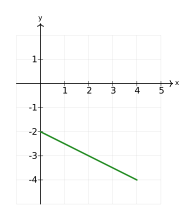
  5. What is the equation of the line shown?
    Slope and the Equations of a Line visual for G8-C03-T03-Q017
    1. \(y=-\frac{1}{2}x-2\)
    2. \(y=-2x-2\)
    3. \(y=\frac{1}{2}x-2\)
    4. \(y=2x-2\)
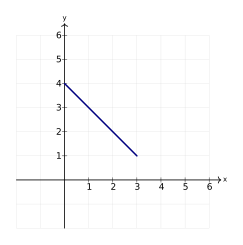
  6. Which ordered pair is a solution to the equation of the line shown?
    Slope and the Equations of a Line visual for G8-C03-T03-Q022
    1. \((1,3)\)
    2. \((2,1)\)
    3. \((4,1)\)
    4. \((3,2)\)
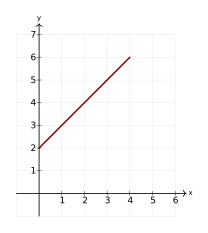
  7. What is the \(y\)-intercept of the line shown?
    Slope and the Equations of a Line visual for G8-C03-T03-Q027
    1. \(1\)
    2. \(4\)
    3. \(3\)
    4. \(2\)
  8. What is the slope represented by the table?

    Slope and the Equations of a Line visual for G8-C03-T03-Q030
    1. \(1\)
    2. \(2\)
    3. \(3\)
    4. \(6\)
Teacher and parent reference

Answer key and explanations

  1. A. \(1\)

    Using points \((0,1)\) and \((4,5)\): slope \(= \frac{5-1}{4-0} = \frac{4}{4} = 1\).

  2. A. \(y=-\frac{1}{2}x+\frac{9}{2}\)

    Using \((1,4)\) and \((5,2)\): slope \(= \frac{2-4}{5-1} = -\frac{1}{2}\). Substituting: \(4 = -\frac{1}{2}(1) + b\) gives \(b = \frac{9}{2}\).

  3. D. \(3\)

    The slope is the rate of change: \(\frac{\Delta y}{\Delta x} = \frac{3}{1} = 3\) (each increase of 1 in \(x\) gives 3 more in \(y\)).

  4. A. \(y=-2x+3\)

    Slope \(= \frac{3-7}{0-(-2)} = \frac{-4}{2} = -2\). When \(x=0\), \(y=3\), so \(b=3\). Thus \(y=-2x+3\).

  5. A. \(y=-\frac{1}{2}x-2\)

    The \(y\)-intercept is \(-2\). Using \((4,-4)\): slope \(= \frac{-4-(-2)}{4-0} = \frac{-2}{4} = -\frac{1}{2}\).

  6. A. \((1,3)\)

    The line passes through \((0,4)\) and \((3,1)\), so slope \(= -1\) and \(y=-x+4\). For \(x=1\), the equation gives \(y=3\), so \((1,3)\) is on the line.

  7. D. \(2\)

    The \(y\)-intercept is where the line crosses the \(y\)-axis, which occurs at \((0,2)\).

  8. C. \(3\)

    As \(x\) increases by 1, \(y\) increases by 3. Slope \(= \frac{\Delta y}{\Delta x} = \frac{3}{1} = 3\).

Free Testinar sample Reviewed November 6, 2026 testinar.com
Page UP

