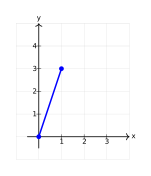
What is the slope of the line shown? \par
- \(2\)
- \(\frac{1}{3}\)
- \(3\)
- \(\frac{3}{2}\)


Learn to reason about and solve Grade 8 problems involving Slope as Rate of Change.
What is the slope of the line shown? \par
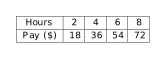
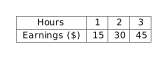
A table shows the relationship between hours worked and pay earned. \par What is the rate of change (slope) of pay with respect to hours worked?
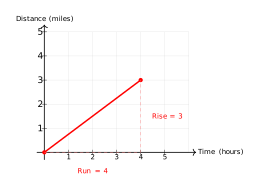
A car travels at a constant speed. The graph shows its distance from the start over time. \par What is the slope (rate of change) of the car's distance?
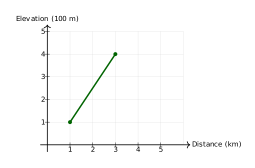
The graph shows elevation change during a hike. \par What is the slope of the line?
A student earns $15 per hour. Which table represents this relationship? \par What is the slope?
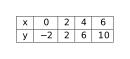
A table shows values for \(x\) and \(y\). What is the rate of change? \par
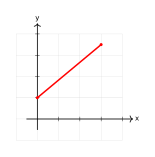
Which graph represents a positive slope? \par
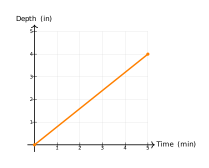
A graph shows depth of water versus time as a pool is filled. \par What is the filling rate (slope)?
The line passes through \((0,0)\) and \((1,3)\). Rise is \(3\) for every \(1\) unit right. The slope is \(\frac{\text{rise}}{\text{run}}=\frac{3}{1}=3\).
Choose two points from the table: \((2, 18)\) and \((4, 36)\). Slope \(= \frac{36-18}{4-2}=\frac{18}{2}=9\) dollars per hour.
The rise is \(3\) miles and the run is \(4\) hours. Slope \(= \frac{3}{4}\) miles per hour. This is the constant speed.
From \((1,1)\) to \((3,4)\): slope \(=\frac{4-1}{3-1}=\frac{3}{2}\).
Using points \((1,15)\) and \((2,30)\): slope \(=\frac{30-15}{2-1}=\frac{15}{1}=15\) dollars per hour.
Using any two points, e.g., \((0,-2)\) and \((2,2)\): slope \(=\frac{2-(-2)}{2-0}=\frac{4}{2}=2\).
The red line goes up as \(x\) increases (positive slope). The blue line goes down as \(x\) increases (negative slope).
From \((0,0)\) to \((5,4)\): slope \(=\frac{4-0}{5-0}=\frac{4}{5}\) inches per minute.
