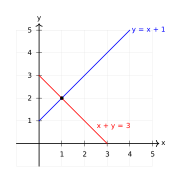
Use the graph below to find the solution to the system of \(y=x+1\) and \(x+y=3\).
- \((1,2)\)
- \((0,3)\)
- \((2,1)\)
- \((3,0)\)


Learn to reason about and solve Grade 8 problems involving Solving Systems of Two Equations.
Use the graph below to find the solution to the system of \(y=x+1\) and \(x+y=3\).
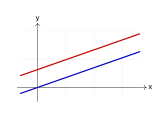
Two lines on a graph do not intersect and are not the same line. How many solutions does the system have?
Use the graph to identify the solution to the system: \(y=-x+5\) and \(y=\frac{3}{4}x-\frac{1}{4}\).
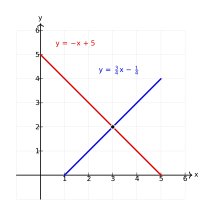
Look at the coordinate grid. Which system of equations has the solution shown by the intersection point?
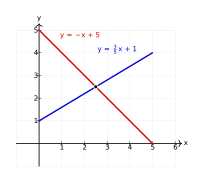
Use the graph below to solve the system.
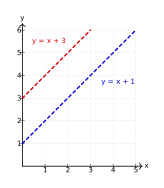
The two lines on the graph below are parallel. Which system do they represent?
Graph the two equations and identify what type of solution the system has.
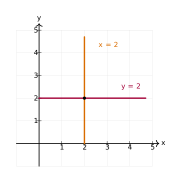
Which ordered pair is the solution to the system shown on the graph?
The two lines intersect at the point marked on the graph. At this point, both \(x=1\) and \(y=2\). Verify: \(y=1+1=2\) ✓ and \(1+2=3\) ✓.
When two distinct lines do not intersect (parallel lines), they have no points in common, so the system has no solution.
The two lines intersect at the marked point. Verify: \(y=-3+5=2\) ✓ and \(y=\frac{3}{4}(3)-\frac{1}{4}=\frac{9}{4}-\frac{1}{4}=2\) ✓.
The graph shows the lines \(y=\frac{3}{5}x+1\) (blue) and \(y=-x+5\) (red) intersecting at \((2.5, 2.5)\).
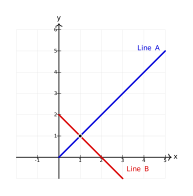
The two lines intersect at the marked point, which is \((1,1)\).
Parallel lines have the same slope but different \(y\)-intercepts. Both lines shown have slope 1 but intercepts 1 and 3.
A horizontal line \(y=2\) and a vertical line \(x=2\) intersect at exactly one point: \((2,2)\).
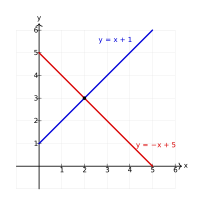
Verify \((2,3)\): \(y=2+1=3\) ✓ and \(y=-2+5=3\) ✓. The marked intersection point is \((2,3)\).
