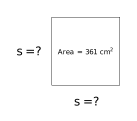
A square has an area of \(361\) square cm. What is its perimeter?
- \(38\) cm
- \(57\) cm
- \(76\) cm
- \(152\) cm


Learn to reason about and solve Grade 8 problems involving Square Roots and Cube Roots.
A square has an area of \(361\) square cm. What is its perimeter?
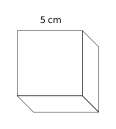
If a cube has a side length of \(5\) cm, what is its volume?
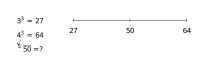
Between which two consecutive integers does \(\sqrt[3]{50}\) lie?
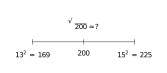
Which is a reasonable approximation for \(\sqrt{200}\)?
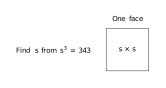
If the volume of a cube is \(343\) cm\(^3\), what is the surface area of one face?
What is \(\sqrt[3]{125}\)?
Which of the following is a perfect square?
What is \(\sqrt{400}\)?
Area \(= 361\), so \(s = \sqrt{361} = 19\) cm. Perimeter \(= 4s = 4 \times 19 = 76\) cm.
Volume of a cube \(= s^3 = 5^3 = 125\) cm\(^3\).
\(3^3 = 27\) and \(4^3 = 64\). Since \(27 < 50 < 64\), we have \(3 < \sqrt[3]{50} < 4\).
\(\sqrt{200} = \sqrt{100 \times 2} = 10\sqrt{2} \approx 10 \times 1.41 = 14.1\). So \(14\) is the closest integer.
Volume \(= s^3 = 343\), so \(s = \sqrt[3]{343} = 7\) cm. One face is a square with side \(7\) cm, so area \(= 7^2 = 49\) cm\(^2\).
\(5\times5\times5=125\), so \(\sqrt[3]{125}=5\).
\(\sqrt{64} = 8\). The other numbers are not perfect squares.
\(20 \times 20 = 400\), so \(\sqrt{400} = 20\).
