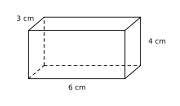
A rectangular prism is shown with dimensions \(6\) cm \(\times\) \(4\) cm \(\times\) \(3\) cm. What is its surface area?
- \(72\) cm\(^2\)
- \(108\) cm\(^2\)
- \(144\) cm\(^2\)
- \(168\) cm\(^2\)


Learn to reason about and solve Grade 8 problems involving Surface Area of Prisms, Cylinders, and Pyramids.
A rectangular prism is shown with dimensions \(6\) cm \(\times\) \(4\) cm \(\times\) \(3\) cm. What is its surface area?
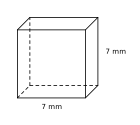
The cube shown has an edge length of \(7\) mm. Calculate its surface area.
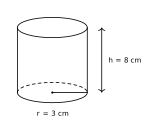
A cylinder has radius \(r = 3\) cm and height \(h = 8\) cm. What is its total surface area? (Use \(\pi \approx 3.14\).)
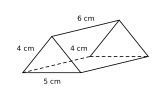
A triangular prism has a triangular base with sides \(5\) cm, \(4\) cm, and \(4\) cm. The height (length) of the prism is \(6\) cm. The height of the triangle is approximately \(3.1\) cm. What is the total surface area?
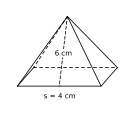
A square pyramid has a square base with side length \(4\) cm and slant height \(6\) cm. What is its total surface area?
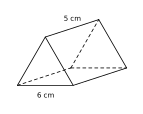
An equilateral triangular prism has triangular bases with side length \(6\) cm and prism length (height) \(5\) cm. The height of each equilateral triangle is approximately \(5.2\) cm. What is the approximate total surface area?
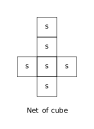
If the net above represents a cube with edge length \(3\) cm, what is the total surface area of the cube?
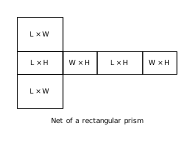
A rectangular prism has dimensions \(4\) cm (L) \(\times\) \(3\) cm (W) \(\times\) \(2\) cm (H). If we unfold it into a net, how many faces does the net show?
\(SA = 2(6 \times 4 + 6 \times 3 + 4 \times 3) = 2(24 + 18 + 12) = 2(54) = 108\) cm\(^2\).
Surface area of a cube \(= 6s^2 = 6(7)^2 = 6(49) = 294\) mm\(^2\). Distractors: \(49\) (one face only), \(196\) (only 4 faces), \(343\) (edge cubed, confusing with volume).
\(SA = 2\pi r^2 + 2\pi rh = 2\pi(3)^2 + 2\pi(3)(8) = 18\pi + 48\pi = 66\pi \approx 66 \times 3.14 = 207.24\) cm\(^2\).
Two triangular bases: \(2 \times \frac{1}{2}(5)(3.1) = 15.5\) cm\(^2\). Three rectangular sides: \(6(5 + 4 + 4) = 78\) cm\(^2\). Total \(= 15.5 + 78 = 93.5\) cm\(^2\).
Base area \(= 4^2 = 16\) cm\(^2\). Four triangular faces each have area \(\frac{1}{2}(4)(6)=12\) cm\(^2\), so the lateral area is \(48\) cm\(^2\). Total surface area \(=16+48=64\) cm\(^2\).
Two triangular bases: \(2 \times \frac{1}{2}(6)(5.2) = 31.2\) cm\(^2\). Three rectangular sides: \(3 \times (6 \times 5) = 90\) cm\(^2\). Total \(\approx 31.2 + 90 = 121.2\) cm\(^2\).
The net shows all 6 faces of a cube. Each face has area \(3^2 = 9\) cm\(^2\). Total surface area \(= 6 \times 9 = 54\) cm\(^2\).
A rectangular prism has 6 rectangular faces (3 pairs of congruent rectangles). A complete net shows all 6 faces.
