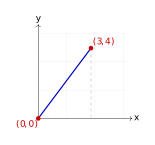
Two points on a coordinate plane are located at \((0, 0)\) and \((3, 4)\). What is the distance between these two points?
- \(5\)
- \(7\)
- \(12\)
- \(25\)


Learn to reason about and solve Grade 8 problems involving The Pythagorean Theorem.
Two points on a coordinate plane are located at \((0, 0)\) and \((3, 4)\). What is the distance between these two points?
A right triangle has legs of length \(6\) and \(8\). What is the length of the hypotenuse?
A right triangle has legs of \(5\) and \(12\). What is the hypotenuse?
In a right triangle, one leg is \(8\) cm and the hypotenuse is \(17\) cm. Find the other leg.
A right triangle has legs of \(3\) and \(4\). Which statement is true?
A ladder leaning against a wall forms a right triangle. The ladder is \(13\) feet long (hypotenuse), and the base is \(5\) feet from the wall. How high up the wall does it reach?
Which set of side lengths forms a right triangle?
A right triangle has legs of \(7\) and \(24\). What is the hypotenuse?
The distance formula uses the Pythagorean Theorem: \(d=\sqrt{(3-0)^2+(4-0)^2}=\sqrt{9+16}=\sqrt{25}=5\) (the 3-4-5 triple).
Pythagorean Theorem: \(a^2+b^2=c^2\), so \(6^2+8^2=c^2\), \(36+64=100\), \(c=\sqrt{100}=10\).
Using the Pythagorean Theorem: \(5^2+12^2=c^2\) gives \(25+144=169\), so \(c=13\) (the 5-12-13 triple).
Rearranging \(a^2+b^2=c^2\): \(8^2+b^2=17^2\) gives \(64+b^2=289\), so \(b^2=225\) and \(b=15\) (the 8-15-17 triple).
The 3-4-5 Pythagorean triple is among the most common. \(3^2+4^2=9+16=25\), so \(c=5\).
The 5-12-13 triple applies: \(5^2+h^2=13^2\) gives \(25+h^2=169\), so \(h=12\) feet.
Check: \(6^2+8^2=36+64=100=10^2\). This is a scaled 3-4-5 triple (all multiplied by 2).
Using the Pythagorean Theorem: \(7^2+24^2=49+576=625\), so \(c=25\) (the 7-24-25 triple).
