Which multiplication step is shown here?
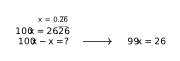
- Multiply by 10 to shift 1 decimal place.
- Multiply by 26 to isolate the repeating part.
- Multiply by 1000 to shift 3 decimal places.
- Multiply by 100 to shift 2 decimal places.


Learn to reason about and solve Grade 8 problems involving Turning Repeating Decimals into Fractions.
Which multiplication step is shown here?
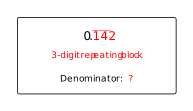
Based on the diagram, what is the denominator when \(0.\overline{142}\) is converted?
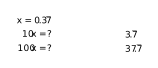
Using the diagram, what is \(100x - 10x\)?
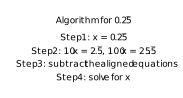
What is \(0.2\overline{5}\) as a fraction?
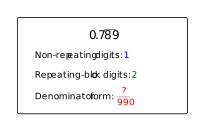
What goes in the numerator when converting \(0.7\overline{89}\)?
Write \(0.\overline{4}\) as a fraction in simplest form.
Convert \(0.\overline{7}\) to a fraction.
What is \(0.\overline{3}\) as a fraction?
The repeating block \(26\) has 2 digits, so we multiply by \(10^2=100\). This shifts the decimal 2 places to align the repeating parts for subtraction.
A 3-digit repeating block always produces a denominator of \(999 = 10^3 - 1\).
\(100x - 10x = 37.\overline{7} - 3.\overline{7} = 34\). The repeating parts cancel, leaving \(90x = 34\).
Following the algorithm: \(100x - 10x = 25.\overline{5} - 2.\overline{5} = 23\), so \(90x = 23\) and \(x = \frac{23}{90}\).
Let \(x=0.7\overline{89}\). Then \(10x=7.\overline{89}\) and \(1000x=789.\overline{89}\). Subtracting gives \(990x=789-7=782\), so the numerator is \(782\).
Let \(x=0.\overline{4}\). Then \(10x=4.\overline{4}\). Subtracting: \(10x-x=4.\overline{4}-0.\overline{4}=4\), so \(9x=4\) and \(x=\frac{4}{9}\).
Let \(x=0.\overline{7}\). Multiply by 10: \(10x=7.\overline{7}\). Subtract: \(10x-x=7\), so \(9x=7\) and \(x=\frac{7}{9}\).
Let \(x=0.\overline{3}\). Then \(10x=3.\overline{3}\). Subtracting: \(9x=3\), so \(x=\frac{3}{9}=\frac{1}{3}\).
