Which number is NOT in correct scientific notation form?
- \(9.99\times10^{2}\)
- \(1.0\times10^{0}\)
- \(0.9\times10^{5}\)
- \(5.05\times10^{-4}\)


Learn to reason about and solve Grade 8 problems involving Understanding Scientific Notation.
Which number is NOT in correct scientific notation form?
Which number is equivalent to \(6.5\times10^{-3}\)?
Convert \(42{,}000\) to scientific notation.
Which of the following equals \(3.8\times10^{2}\)?
The distance from Earth to the Sun is approximately \(1.496\times10^{8}\) km. What is this distance in standard form?
Write \(0.000284\) in scientific notation.
The diameter of an atom is about \(2\times10^{-10}\) m. What is this in decimal form?
Which number is written in correct scientific notation?
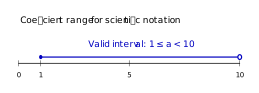
The coefficient \(0.9\) is less than \(1\), violating the requirement that it must be in \([1, 10)\).
A negative exponent shifts the decimal to the left. Move the decimal \(3\) places left: \(6.5\times10^{-3}=0.0065\).
Move the decimal \(4\) places left to get \(4.2\); the exponent is positive \(4\). Thus \(42{,}000=4.2\times10^{4}\).
A positive exponent shifts the decimal to the right. Move the decimal \(2\) places right: \(3.8\times10^{2}=380\).
Move the decimal \(8\) places right: \(1.496\times10^{8}=149{,}600{,}000\) km.
Move the decimal \(4\) places right to get \(2.84\); the exponent is negative \(4\) (because the original number is less than \(1\)).
A negative exponent means move the decimal to the left. With \(10^{-10}\), move \(10\) places left: \(2\times10^{-10}=0.0000000002\) m.
Scientific notation requires the coefficient to be at least \(1\) but less than \(10\). Only \(6.0\times10^{3}\) meets this condition.
