A cone has a radius of \(5\) m and a height of \(12\) m. What is its volume? Use \(\pi\approx 3.14\).
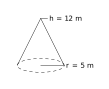
- \(314\) m\(^3\)
- \(942\) m\(^3\)
- \(1884\) m\(^3\)
- \(2826\) m\(^3\)


Learn to reason about and solve Grade 8 problems involving Volume of Cylinders, Cones, and Spheres.
A cone has a radius of \(5\) m and a height of \(12\) m. What is its volume? Use \(\pi\approx 3.14\).
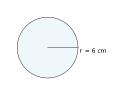
A sphere has a radius of \(6\) cm. Approximately, what is its volume? Use \(\pi \approx 3.14\).
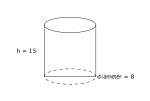
A student needs to find the volume of a cylinder with diameter \(8\) in and height \(15\) in. Which formula setup is correct? (Use \(\pi \approx 3.14\).)
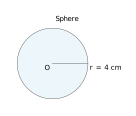
A sphere with radius \(4\) cm is shown. What is its approximate volume? (Use \(\pi \approx 3.14\).)
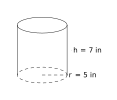
A cylinder with radius \(5\) in and height \(7\) in is shown. What is its volume? (Use \(\pi \approx 3.14\).)
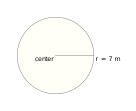
A sphere with radius \(7\) m is shown. What is its approximate volume? (Use \(\pi \approx 3.14\).)
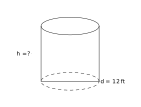
A cylinder has a diameter of \(12\) ft and volume of \(1130.4\) ft\(^3\). What is its height? (Use \(\pi \approx 3.14\).)
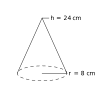
A traffic cone used at a construction site has a radius of \(8\) cm and height of \(24\) cm. What is its volume? (Use \(\pi \approx 3.14\).)
Volume of a cone: \(V=\frac{1}{3}\pi r^2 h=\frac{1}{3}\times3.14\times 5^2 \times 12 = \frac{1}{3}\times 942 = 314\) m\(^3\).
Volume of a sphere: \(V=\frac{4}{3}\pi r^3 = \frac{4}{3}\times 3.14 \times 6^3 = \frac{4}{3}\times 3.14 \times 216 = \frac{4}{3}\times678.24 = 904.32\) cm\(^3\).
The radius is half the diameter: \(r = 8 \div 2 = 4\) in. Cylinder volume: \(V = \pi r^2 h = 3.14 \times 4^2 \times 15\).
\(V = \frac{4}{3}\pi r^3 = \frac{4}{3} \times 3.14 \times 4^3 = \frac{4}{3} \times 3.14 \times 64 \approx 267.95\) cm\(^3\).
\(V = \pi r^2 h = 3.14 \times 5^2 \times 7 = 3.14 \times 25 \times 7 = 549.5\) in\(^3\).
\(V = \frac{4}{3}\pi r^3 = \frac{4}{3} \times 3.14 \times 343 \approx 1436.03\) m\(^3\).
Radius \(r = 6\) ft. From \(V = \pi r^2 h\): \(1130.4 = 3.14 \times 36 \times h \Rightarrow h = \frac{1130.4}{113.04} = 10\) ft.
\(V = \frac{1}{3}\pi r^2 h = \frac{1}{3} \times 3.14 \times 64 \times 24 = \frac{1}{3} \times 4815.36 = 1605.12\) cm\(^3\).
