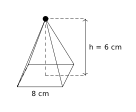
The square pyramid below has a base edge of \(8\) cm and a height of \(6\) cm. What is the volume of the pyramid?
- \(64\) cm\(^3\)
- \(128\) cm\(^3\)
- \(256\) cm\(^3\)
- \(384\) cm\(^3\)


Learn to reason about and solve Grade 8 problems involving Volume of Pyramids.
The square pyramid below has a base edge of \(8\) cm and a height of \(6\) cm. What is the volume of the pyramid?
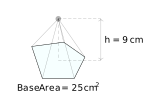
A pyramid with a pentagonal base has a base area of \(25\) cm\(^2\) and a height of \(9\) cm. What is its volume?
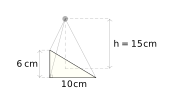
A pyramid has a right-triangular base with legs \(10\) cm and \(6\) cm. The pyramid height is \(15\) cm. What is its volume?
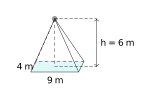
A pyramid has a rectangular base of \(9\) m by \(4\) m and a height of \(6\) m. What is its volume?
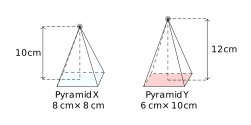
Pyramid X has a square base with side \(8\) cm and height \(10\) cm. Pyramid Y has a rectangular base of \(6\) cm by \(10\) cm and height \(12\) cm. Which pyramid has the larger volume?
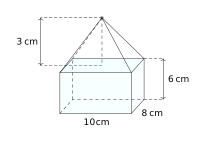
A rectangular prism with base \(10\) cm by \(8\) cm and height \(6\) cm is topped with a pyramid (same base, height \(3\) cm). What is the total volume?
A square pyramid has a base edge of \(6\) inches and a height of \(9\) inches. What is its volume?
A rectangular pyramid has a base that is \(4\) cm by \(5\) cm and a height of \(12\) cm. What is the volume?
\(V=\frac{1}{3}\times(8\times8)\times6=\frac{1}{3}\times64\times6=128\) cm\(^3\).
\(V=\frac{1}{3}\times25\times9=75\) cm\(^3\).
Base area: \(B=\frac{1}{2}\times10\times6=30\) cm\(^2\). Volume: \(V=\frac{1}{3}\times30\times15=150\) cm\(^3\).
\(B=9\times4=36\) m\(^2\). \(V=\frac{1}{3}\times36\times6=72\) m\(^3\).
\(V_X=\frac{1}{3}\times64\times10\approx213.3\) cm\(^3\). \(V_Y=\frac{1}{3}\times60\times12=240\) cm\(^3\). Pyramid Y is larger.
Prism volume: \(10\times8\times6=480\) cm\(^3\). Pyramid volume: \(\frac{1}{3}\times(10\times8)\times3=80\) cm\(^3\). Total volume is \(480+80=560\) cm\(^3\).
Volume of a pyramid: \(V=\frac{1}{3}\cdot B\cdot h=\frac{1}{3}\times(6\times6)\times9=\frac{1}{3}\times36\times9=108\) in\(^3\).
\(V=\frac{1}{3}\times B\times h=\frac{1}{3}\times(4\times5)\times12=\frac{1}{3}\times20\times12=80\) cm\(^3\).
