The table below shows a relation. Is it a function?
- No, because the outputs are larger than inputs.
- Yes, each input has exactly one output.
- No, because \(y\) values increase by 3.
- Yes, because all values are positive.
Learn to reason about and solve Grade 8 problems involving What Is a Function?.
The table below shows a relation. Is it a function?
Which table represents a function?
Which graph does NOT represent a function?
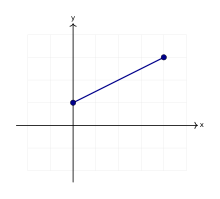
What is the domain of the graphed function?
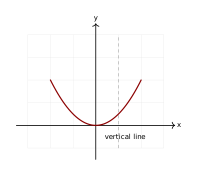
A vertical line test is performed on the graph below. How many times does a vertical line intersect the curve?
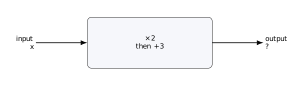
A function machine multiplies the input by 2 and adds 3. If the input is \(x\), what is the output?
Which table represents a function where the output is always greater than the input?
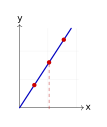
Is the graph of a straight line passing through \((1,2)\) and \((3,6)\) a function?
Each input value (\(1, 2, 3, 4\)) corresponds to exactly one output value (\(3, 6, 9, 12\)). The relationship is \(y = 3x\), making it a function.
Table A has input 2 appearing twice with different outputs (5 and 6), so it is not a function. Table B has each unique input paired with exactly one output.
A sideways parabola (opening right or left) fails the vertical line test because some vertical lines intersect it twice. The other options all pass the vertical line test.
The segment starts at \(x=0\) and ends at \(x=4\). The domain includes all \(x\)-values in this range: \([0, 4]\).
The parabola opens upward and any vertical line intersects it at most once (or once in the visible region shown). This confirms it is a function.
Multiply by 2 first: \(2x\). Then add 3: \(2x + 3\).
Table A: outputs are \(3, 5, 7, 9\) and inputs are \(1, 2, 3, 4\) — all outputs are greater. Table B: when \(x=0\), \(y=0\) (equal, not greater).
Non-vertical straight lines pass the vertical line test and are functions. Every vertical line intersects the graph at most once.