




Introduction
In Grade 5, use place value understanding to round decimals to any place. They apply rounding to estimate answers and check the reasonableness of results in problem-solving contexts.
Rounding Decimals matters because it blends concept understanding, visual reasoning, and accurate practice. When students can explain the math, model it, and apply it in context, they build confidence that carries into quizzes, classwork, and bigger Grade 5 problem solving.
What Is Rounding Decimals?
Rounding Decimals is the Grade 5 skill of students use place value understanding to round decimals to any place. They apply rounding to estimate answers and check the reasonableness of results in problem-solving contexts.
Strong understanding comes from naming what the numbers, shapes, units, or data values represent, then showing the idea with a model or clear steps before solving.
Understanding Rounding Decimals
The key to this topic is understanding the structure behind the work, not just following a rule. Students should be able to talk through what is happening, point to a model, and explain why the answer makes sense.
- Name the place of each important digit before comparing or computing.
- Use place value patterns to explain what happens when values shift.
- Estimate first so the final answer can be checked for reasonableness.
- Use the topic language from class discussions: Students use place value understanding to round decimals to any place. They apply rounding to estimate answers and check the reasonableness of results in problem-solving contexts.
Visual Models
Visual Model 1
Question: Round 23.45 to the nearest whole number.
| Tens | Ones | Tenths | Hundredths |
|---|---|---|---|
| 2 | 3 | 4 | 5 |
- A. 23
- B. 23.4
- C. 23.5
- D. 24
How the model helps: The tenths place is 4. Since 4 is less than 5, round down. 23.45 rounded to the nearest whole number is 23.
Visual Model 2
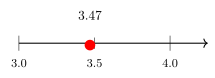
Question: A number line shows the position of 3.47 between 3 and 4. What is 3.47 rounded to the nearest whole number?
- A. 4.0
- B. 3.5
- C. 3.7
- D. 3
How the model helps: 3.47 is between 3 and 4, but closer to 3 because the tenths digit 4 is less than 5. It rounds down to 3.
Step-by-Step Examples
Example 1
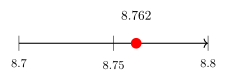
Question: Maria measures 8.762 meters of ribbon. If she rounds to the nearest tenth for her project, how much does she use?
- A. 8.7 m
- B. 8.76 m
- C. 8.8 m
- D. 9 m
- The tenths place is 7, hundredths is 6.
- Since 6 \(\geq\) 5, round up: 7 becomes 8.
- Maria uses 8.8 meters.
Answer: 8.8 m
Example 2
Question: What is the place-value chart showing for 3.456? When \(3.456\) is rounded to the nearest hundredth, which digit changes because the thousandths digit is 6?
| Ones | Tenths | Hundredths | Thousandths |
|---|---|---|---|
| 3 | 4 | 5 | 6 |
- A. The ones digit, 3
- B. The tenths digit, 4
- C. The thousandths digit, 6
- D. The hundredths digit, 5
- The thousandths digit 6 tells whether to round up.
- Since 6 \(\geq\) 5, the hundredths digit changes from 5 to 6.
Answer: The hundredths digit, 5
Example 3
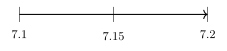
Question: Which number would round to 7.2 when rounding to the nearest tenth?
- A. 7.14
- B. 7.19
- C. 7.25
- D. 7.34
- 7.19 has a tenths digit of 1 and hundredths digit of 9.
- Since 9 \(\geq\) 5, round the tenths up from 1 to 2, giving 7.2.
Answer: 7.19
Real-World Word Problems
Problem 1
Question: A store item costs $12.456. Round to the nearest cent (hundredth of a dollar).
- $12.45
- $12.46
- $12.50
- $12.60
Answer: $12.46
Why it works: Rounding \(12.456 to the nearest cent (hundredth): the thousandths digit is 6. Since \)6 \geq 5\(, round the hundredths digit up: 5 becomes 6, giving \)12.46.
Problem 2
Question: A distance is 8.642 km. If rounded to the nearest tenth, what is it?
- A. 8.6 km
- B. 8.64 km
- C. 8.7 km
- D. 9 km
Answer: 8.6 km
Why it works: The tenths digit is 6. The hundredths digit is 4. Since 4 < 5, keep tenths as 6. So 8.642 rounds to 8.6 km.
Common Mistakes
- Starting the computation before identifying what the numbers, units, or parts represent.
- Ignoring place value by lining up digits incorrectly instead of aligning decimal points or decimal places.
- Forgetting to estimate, which makes it easier to miss an unreasonable answer.
- Stopping at a number without explaining what the answer means in context.
Strategy Tips
- Read the situation slowly and name what each number or label represents.
- Use place value charts or aligned digits to keep the decimal meaning clear.
- Estimate first so you already know the answer's approximate size.
- Check the answer with an inverse operation, another representation, or a sentence explanation.
- Say the math idea out loud in simple words before writing the final answer.
Practice Questions
Question 1
Test Text What is 47.863 rounded to the nearest tenth?
- A. 47.8
- B. 47.86
- C. 47.9
- D. 48.0
Question 2
What is 5.678 rounded to the nearest hundredth?
- A. 5.67
- B. 5.68
- C. 5.7
- D. 6.0
Question 3
Round 12.542 to the nearest tenth.
- A. 12.4
- B. 13.0
- C. 12.6
- D. 12.5
Question 4
Round 9.951 to the nearest hundredth.
- A. 9.95
- B. 9.96
- C. 10.0
- D. 9.9
Question 5
Round 34.196 to the nearest whole number.
- A. 34
- B. 34.1
- C. 34.2
- D. 35
Question 6
A package weighs 6.846 kg. Round to the nearest hundredth for shipping records.
- A. 6.8 kg
- B. 6.84 kg
- C. 6.85 kg
- D. 7 kg
Full Answer Explanations Click to show all answers and explanations
Question 1
Answer: 47.9
Explanation Text The tenths place in 47.863 is 8. The hundredths place is 6. Since 6 is greater than or equal to 5, we round the tenths digit up from 8 to 9. Therefore, 47.863 rounded to the nearest tenth is 47.9.
Question 2
Answer: 5.68
The hundredths place is 7. The thousandths place is 8. Since 8 \(\geq\) 5, round up from 7 to 8. So 5.678 rounds to 5.68.
Question 3
Answer: 12.5
The tenths place is 5. The hundredths place is 4. Since 4 < 5, keep 5. So 12.542 rounds to 12.5.
Question 4
Answer: 9.95
The hundredths place is 5. The thousandths place is 1. Since 1 < 5, keep the hundredths digit the same. So 9.951 rounds to 9.95.
Question 5
Answer: 34
The tenths digit is 1. Since 1 < 5, round down. 34.196 rounded to the nearest whole number is 34.
Question 6
Answer: 6.85 kg
Rounding 6.846 to the nearest hundredth: the thousandths digit is 6. Since \(6 \geq 5\), round the hundredths digit up: 4 becomes 5, giving 6.85 kg.
Connection to Standards
Rounding Decimals supports important Grade 5 math thinking because students are expected to students use place value understanding to round decimals to any place. They apply rounding to estimate answers and check the reasonableness of results in problem-solving contexts.
Strong work in this topic means more than getting the answer. Students should be able to model the idea, explain the reasoning, choose an efficient strategy, and apply the concept in classwork and real situations.
Summary
Rounding Decimals gets easier when students read the model, track what each number means, and explain why the answer fits the situation.
GOLDEN RULE
Name the place value first, then compute or compare with aligned digits.