Grades 8-12Free, no account needed
Compound growth calculator
Study fixed-rate compound growth, its exact formula and a simple-versus-compound comparison without contributions.
Try your problem
Supported inputs and limits
Principal 0-1000000; annual percentage rate 0-100; years 0-100. n is 1, 2, 4, 12 or 365. Whole-periods requires integer n*t. Fractional-periods explicitly extends the exponent formula without assuming a payout policy. Exact rational input up to 40 characters, nine finite decimal places and reduced denominator <=1000000000. Up to 24 whole periods produce an exact fraction; longer or fractional periods retain an exact power expression and approximate decimal (10 significant digits). No currency rounding or contributions. Paste compound(1000,10,1,2,whole-periods), at most 200 characters.
Step by step
Understand the method
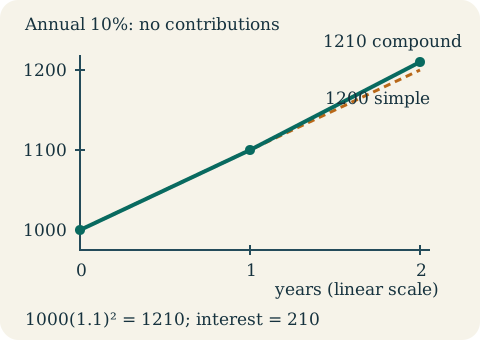
Compound growth applies each period's rate to the current balance, including previous growth. If P is the starting principal, r is the annual rate as a fraction, n is periods per year and t is years, each period multiplies the balance by 1 + r/n. After nt whole periods the balance is A = P(1 + r/n)^(nt). Interest earned is A - P.
Simple growth instead uses the original principal every time: A_simple = P(1 + rt). At a nonnegative rate, whole-period compounding is at least as large after one or more periods. A fractional power is a mathematical extension between period endpoints, not a universal payout convention. This educational model excludes contributions, withdrawals, fees, taxes, inflation, variable rates and day-count rules; it is not financial advice.
Worked examples
Read the reasoning, or load an example into the calculator.
Growth on prior growth
1000 at 10 percent annually for two years gives 1000(1.1)^2 = 1210, with interest 210. Simple growth gives 1200.
Monthly periods
At 12 percent annually, monthly rate = 0.12/12 = 0.01. Three months is 1/4 year, so 200(1.01)^3 = 206.0602 exactly.
A fractional-period model
With annual compounding and half a year, the extension gives 100(1.21)^(1/2) = 110 mathematically. This is a power-model example, not an institutional payout promise.
Try it without the calculator
Three questions for practice, not a graded school assessment. Your answers stay on this page and are not saved.
Original Testinar learning content. This local preview is awaiting final review before publication.