Algebra 2Free, no account needed
Logarithm calculator
Explore common, natural and custom-base logarithms through inverse powers, exact expressions and a live graph.
Try your problem
Supported inputs and limits
Value and custom base: 1/1000000000 to 1000000000; base must differ from 1 by at least 1/1000000. Natural/common modes ignore the base field. Exact rational input up to 40 characters, nine finite decimal places and reduced denominator <=1000000000; no scientific notation or expressions. Logarithmic expressions stay exact; decimals are approximate to 10 significant digits. Paste log(2,32), ln(2) or log10(100), at most 200 characters. Graph scales are linear; extreme ranges compress small inputs.
Step by step
Understand the method
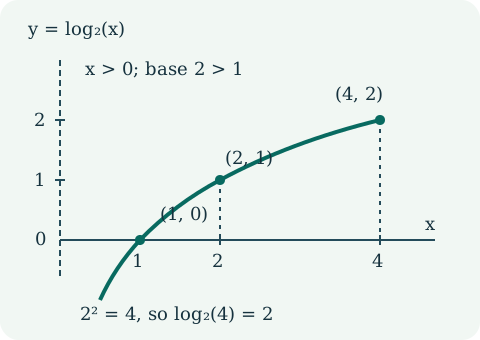
A logarithm asks an exponent question: log base b of x is the exponent y for which b^y = x. In real arithmetic, x and b must be positive and b cannot equal 1. Common logarithms use base 10; natural logarithms use e. The point (1,0) belongs to every allowed logarithm graph because b^0 = 1.
Taking natural logarithms of b^y = x gives y ln(b) = ln(x), so y = ln(x)/ln(b). When b > 1, increasing x increases y. For 0 < b < 1, powers decrease as the exponent increases, so the logarithm graph decreases. The vertical line x = 0 is an excluded asymptote, never a logarithm input.
Worked examples
Read the reasoning, or load an example into the calculator.
An inverse power
2^5 = 32, so log base 2 of 32 is exactly 5. Change of base evaluates ln(32)/ln(2) to approximately 5.
A decreasing base
(1/2)^3 = 1/8, so log base 1/2 of 1/8 is exactly 3. A smaller input gives a larger exponent for this base.
A natural logarithm
ln(2) is an exact expression, approximately 0.6931471806. Exponentiating e to that unrounded value reconstructs 2.
Try it without the calculator
Three questions for practice, not a graded school assessment. Your answers stay on this page and are not saved.
Original Testinar learning content. This local preview is awaiting final review before publication.