Grades 7-10Free, no account needed
Integer exponent rules calculator
Apply same-base product, quotient and power laws with integer exponents, exact values, domain checks and signed factor-count models.
Try your problem
Supported inputs and limits
Base x uses exact rational engine syntax, at most 40 characters, magnitude <= 10000 and reduced numerator/denominator <= 1000000; up to 9 finite decimal places, repeating prefix/block <= 6 digits, and engine raw-number caps apply. m and n are integers -12 through 12; the combined exponent can be -144 through 144. 0^0 is undefined; zero base requires m,n > 0 and a non-division mode. Results are exact, sometimes hundreds of digits. The signed-cell model is schematic, not a magnitude plot. Paste multiply(x,m,n), divide(x,m,n) or power(x,m,n), at most 200 characters; arguments are integers, finite decimals or integer fractions, with m,n still required to be integer tokens.
Step by step
Understand the method
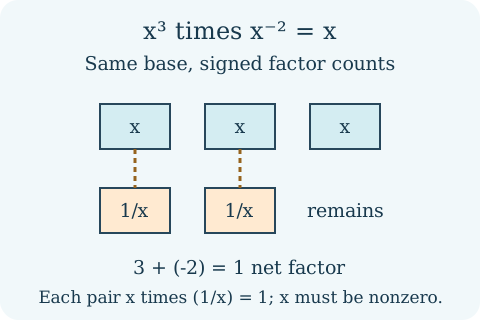
Multiplying powers with the same base adds their exponents: x^m times x^n = x^(m+n). Dividing subtracts exponents because the denominator factors are inverted: x^m / x^n = x^(m-n). Raising a power to a power multiplies exponents: (x^m)^n = x^(mn). Signed exponent cells model factors and reciprocals, not the numerical size of a power.
For a nonzero base, x^0 = 1 and x^(-k) = 1/x^k. A negative exponent is not a negative sign on the answer. This tool uses 0^0 as undefined; negative powers of zero and division by zero are also undefined. Check the original expression before simplifying: 0^3 / 0^2 is not zero even though the exponent subtraction would leave 1. At zero, only positive m and n in multiplication or power mode are accepted.
Worked examples
Read the reasoning, or load an example into the calculator.
Cancellation in a product
2^3 times 2^-2 = 2^(3 - 2) = 2. Independently, 8 times 1/4 = 2. Two reciprocal pairs cancel.
Subtract a negative exponent
(1/2)^2 / (1/2)^-1 = (1/2)^3 = 1/8. Independently, (1/4)/2 = 1/8; subtracting -1 adds 1.
A reciprocal outer power
((-2)^3)^-2 = (-2)^-6 = 1/64. The inner power is -8; its negative second power is 1/(-8)^2 = 1/64.
Try it without the calculator
Three questions for practice, not a graded school assessment. Your answers stay on this page and are not saved.
Original Testinar learning content. This local preview is awaiting final review before publication.