Grades 7-10Free, no account needed
Coordinate transformation calculator
Translate, reflect or rotate up to six supplied points with exact coordinates, inverse checks and equal-scale original/result geometry.
Try your problem
Supported inputs and limits
1-6 x,y pairs separated by |; points field<=320 characters. Coordinates and translation components have magnitude<=1000000. Scalars: signed integers, finite decimals with up to6 places, or integer fractions with positive denominator; <=24 characters, parts<=12 digits, reduced denominator<=1000000. No expressions. All results are exact rationals. Translation alone reads dx,dy. Rotations only90/180/270 about the origin; reflections only axes/origin. Paste transform(translate;1,2|3,1;2;-1) or transform(rotate90;1,2), <=200 characters. Plot offsets/common scale are disclosed; exact tables distinguish overlaps.
Step by step
Understand the method
A rigid transformation preserves distances between points. Translation adds one vector (u,v) to every point: (x,y) becomes (x+u,y+v). Reflection across the x-axis changes only y to -y; reflection across the y-axis changes only x to -x.
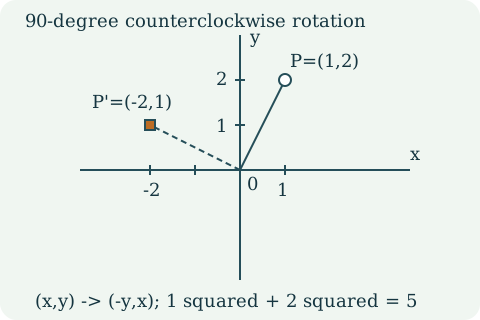
Counterclockwise rotations about the origin use the exact rules90 degrees: (-y,x),180 degrees: (-x,-y),270 degrees: (y,-x). Reflection through the origin has the same coordinates as rotation180. Applying the inverse returns the original points; squared distances give a separate verification.
Worked examples
Read the reasoning, or load an example into the calculator.
Translate a pair
Adding (2,-1) maps (1,2) to (3,1) and (3,1) to (5,0). Squared distance remains5.
Reflect signed fractions
Reflection across the x-axis maps (-1,1/2) to (-1,-1/2). The x coordinate and distance from the axis are preserved.
A quarter-turn
Rotation90 counterclockwise maps (1,2) to (-2,1). Both squared distances from the origin are5; rotating back270 restores the input.
Try it without the calculator
Three questions for practice, not a graded school assessment. Your answers stay on this page and are not saved.
Original Testinar learning content. This local preview is awaiting final review before publication.