Algebra 2Free, no account needed
2 by 2 matrix calculator
Find an exact determinant, inverse or ordered matrix product, with row-column arithmetic, identity checks and truthful unit-square images.
Try your problem
Supported inputs and limits
Modes determinant, inverse and product. Active entries have magnitude <=1,000 and reduced denominator <=1,000,000, each <=24 characters: integer, fraction with positive denominator or finite decimal <=6 places. Matrix A uses a,b,c,d in row-major order; B uses e,f,g,h only in product mode. Inactive B entries are ignored. Exact arithmetic, including singular and zero matrices; singular inverse returns undefined. Diagram coordinates approximate with equal x/y scale per independently fitted panel; thin shapes may be unresolved. Paste <=200 characters: matrix(inverse;1;2;3;4) or matrix(product;1;2;0;1;2;0;1;2).
Step by step
Understand the method
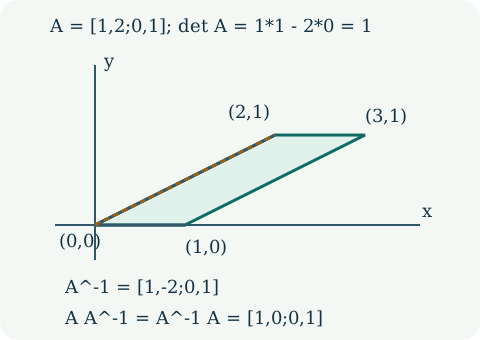
For A=[a,b;c,d], determinant is ad-bc. Its sign describes orientation and its absolute value is the area scale for the parallelogram spanned by the two columns. A zero determinant collapses the unit square to a segment or point and means there is no inverse.
For nonzero determinant, swap a and d, negate b and c, and divide every entry by ad-bc. This adjugate formula gives A^-1. Verify both A*A^-1 and A^-1*A equal the identity matrix. A singular matrix is valid input with an undefined inverse, not a malformed number.
To multiply A by B=[e,f;g,h], each output entry is the dot product of one A row with one B column. The first entry is ae+bg, not ae alone. For transformations B acts first, then A; AB generally differs from BA. A useful independent check is det(AB)=det(A)*det(B).
Worked examples
Read the reasoning, or load an example into the calculator.
A signed area scale
For A=[1,2;3,4], det(A)=1*4-2*3=-2. The column parallelogram has unsigned area 2 and reversed orientation.
A singular inverse is undefined
For A=[1,2;2,4], determinant is 4-4=0. Its columns are dependent, its unit-square image is a segment, and no inverse exists.
An ordered product
For A=[1,2;0,1] and B=[2,0;1,2], AB=[4,4;1,2]. The determinant 4 equals det(A)*det(B)=1*4.
A genuine inverse
For A=[1,2;3,4], A^-1=[-2,1;3/2,-1/2]. Multiplication in either order gives [1,0;0,1].
Try it without the calculator
Three questions for practice, not a graded school assessment. Your answers stay on this page and are not saved.
Original Testinar learning content. This local preview is awaiting final review before publication.