Algebra 2Free, no account needed
Complex number arithmetic calculator
Calculate exact arithmetic with two complex numbers, inspect the result conjugate and squared magnitudes, and compare them on a complex plane.
Try your problem
Supported inputs and limits
Each component has magnitude <=10,000 and reduced denominator <=1,000,000. Fields accept signed integers, fractions with positive integer denominator, or finite decimals with at most 6 places; each token <=24 characters, no mixed/repeating forms or expressions. All four operations use all four components. Division by zero is rejected at c. Exact rational outputs; equal-axis plot positions are approximate and extreme/coincident points may overlap. Paste <=200 characters: complex(divide;3;2;1;-1), with mode add, subtract, multiply or divide and a;b;c;d in that order.
Step by step
Understand the method
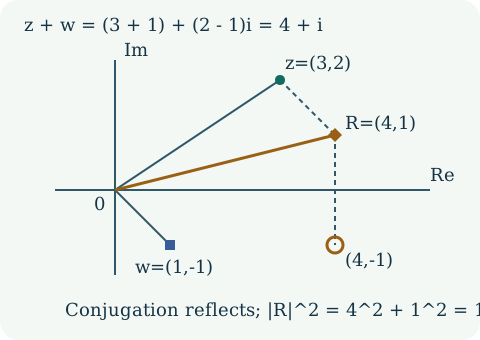
Write the first number as z=a+bi and the second as w=c+di, where a,b,c,d are real and i^2=-1. Addition and subtraction combine real components and imaginary coefficients separately. A point (a,b) on the complex plane represents a+bi, not an ordered pair of two unrelated numbers.
Distributing a product gives ac+(ad+bc)i+bd*i^2, so the result is (ac-bd)+(ad+bc)i. To divide by nonzero c+di, multiply top and bottom by c-di. The denominator becomes c^2+d^2; the real numerator is ac+bd and the imaginary numerator is bc-ad.
Conjugation changes the sign of the imaginary coefficient and reflects the point across the real axis. Squared magnitude is a^2+b^2, whereas magnitude is its nonnegative square root. Undo addition/subtraction or multiply a quotient by its divisor to check arithmetic; squared magnitudes multiply when complex numbers multiply.
Worked examples
Read the reasoning, or load an example into the calculator.
Combine components
(3+2i)+(1-i)=4+i. Subtracting 1-i recovers 3+2i; the result conjugate is 4-i and its squared magnitude is 17.
Use the imaginary-unit square
(1+2i)(3-4i)=3-4i+6i-8i^2=11+2i. Its squared magnitude 125 equals 5 times 25.
Divide using the conjugate
(3+2i)/(1-i)=(1+5i)/2=1/2+(5/2)i. Multiplying the quotient by 1-i returns 3+2i.
Try it without the calculator
Three questions for practice, not a graded school assessment. Your answers stay on this page and are not saved.
Original Testinar learning content. This local preview is awaiting final review before publication.