Algebra 1-2Free, no account needed
Quadratic factoring calculator
Factor a rational quadratic in its honest number field, classify irreducibility, and check the expanded coefficients exactly.
Try your problem
Supported inputs and limits
Exact rational inputs, at most 40 characters each; magnitude <= 10000 and reduced numerator/denominator <= 1000000. Engine syntax supports integers, fractions, mixed numbers, up to 9 finite decimal places, and repeating decimals with prefix/block <= 6 digits; engine raw-number caps also apply. Zero a becomes linear or constant. Radicals may remain unsimplified; real irrational estimates use 7 significant digits and approximate signs. Graph positions are approximate, with independently scaled axes. Paste factor(a,b,c), at most 200 characters, with integer, finite-decimal or integer-fraction arguments only.
Step by step
Understand the method
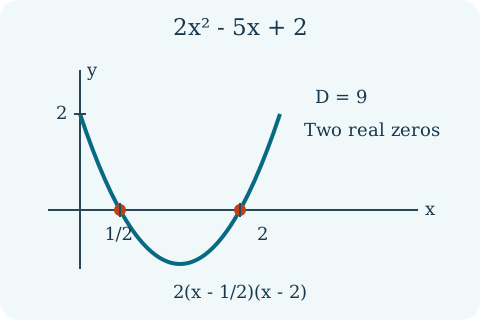
Factoring reverses multiplication. For a nonzero quadratic coefficient, zeros r1 and r2 give ax^2 + bx + c = a(x - r1)(x - r2). The outside a is essential. Compute D = b^2 - 4ac exactly: a positive rational square gives rational zeros, zero gives a repeated rational zero, and a positive nonsquare gives real irrational zeros.
Irreducible depends on the allowed coefficients. A rational quadratic with positive nonsquare D cannot split into rational linear factors but can split over the reals using radicals. Negative D prevents real linear factors; it splits over the complex numbers using i^2 = -1. This tool labels that difference rather than inventing integer factors. Verify by the root sum -b/a, root product c/a, and expansion of every coefficient.
Worked examples
Read the reasoning, or load an example into the calculator.
Rational linear factors
D = 25 - 16 = 9. The roots are 2 and 1/2, giving 2(x - 2)(x - 1/2); expansion recovers 2x^2 - 5x + 2.
Real but not rational factors
x^2 - 2 has roots sqrt(2) and -sqrt(2). Its real factors are (x - sqrt(2))(x + sqrt(2)), but it is irreducible over the rationals.
Complex conjugate factors
x^2 + 1 has D = -4, roots i and -i, and complex factors (x - i)(x + i). It has no real linear factors or real intercepts.
A repeated factor
x^2 - 6x + 9 has D = 0 and repeated root 3, so it equals (x - 3)^2.
Try it without the calculator
Three questions for practice, not a graded school assessment. Your answers stay on this page and are not saved.
Original Testinar learning content. This local preview is awaiting final review before publication.