Algebra 1-2Free, no account needed
Completing the square calculator
Rewrite ax^2 + bx + c as a(x - h)^2 + k with an exact identity, expansion check and current parabola.
Try your problem
Supported inputs and limits
Exact rational inputs, at most 40 characters each; magnitude <= 10000 and reduced numerator/denominator <= 1000000. Engine syntax supports integers, fractions, mixed numbers, up to 9 finite decimal places, and repeating decimals with prefix/block <= 6 digits; engine raw-number caps also apply. a must be nonzero. Vertex form and expansion are exact; graph coordinates and independently scaled axes are approximate. Paste square(a,b,c), at most 200 characters, with integer, finite-decimal or integer-fraction arguments only.
Step by step
Understand the method
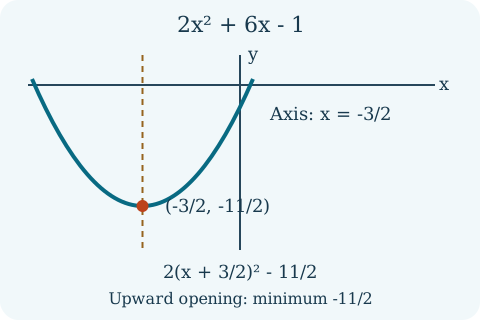
Completing the square preserves an expression, not just its zeros. Factor a from the x^2 and x terms to obtain a[x^2 + (b/a)x] + c. Half the inside linear coefficient is b/(2a). Add and subtract its square inside the bracket so the total change is zero. The first three terms become a perfect square.
After distributing the correction, h = -b/(2a) and k = c - b^2/(4a), giving a(x - h)^2 + k. Since the squared part is nonnegative, the vertex is (h,k): a positive a makes k a minimum and a negative a makes k a maximum. The line x = h is the symmetry axis. Expand the vertex form to check the original x and constant coefficients exactly.
Worked examples
Read the reasoning, or load an example into the calculator.
A nonmonic upward parabola
2[x^2 + 3x] - 1 = 2[(x + 3/2)^2 - 9/4] - 1 = 2(x + 3/2)^2 - 11/2. The minimum is -11/2.
A downward parabola
-x^2 + 4x + 1 = -(x - 2)^2 + 5. The vertex (2,5) is a maximum, so the range is y <= 5.
Fractional coefficients
(1/2)x^2 - (1/3)x + 2 = (1/2)(x - 1/3)^2 + 35/18. Expanding the constant gives 1/18 + 35/18 = 2.
Try it without the calculator
Three questions for practice, not a graded school assessment. Your answers stay on this page and are not saved.
Original Testinar learning content. This local preview is awaiting final review before publication.