Grades 8-10Free, no account needed
Quadratic function evaluation calculator
Evaluate ax^2 + bx + c at an exact rational input t, show signed substitution, and check with Horner form.
Try your problem
Supported inputs and limits
Exact rational inputs, at most 40 characters each; magnitude <= 10000 and reduced numerator/denominator <= 1000000. Engine syntax supports integers, fractions, mixed numbers, up to 9 finite decimal places, and repeating decimals with prefix/block <= 6 digits; engine raw-number caps also apply. Quadratic, linear and constant functions are supported. Results and sample coordinates are exact; plot positions and independently scaled axes are approximate. Paste evaluate(a,b,c,t), at most 200 characters, with integer, finite-decimal or integer-fraction arguments only.
Step by step
Understand the method
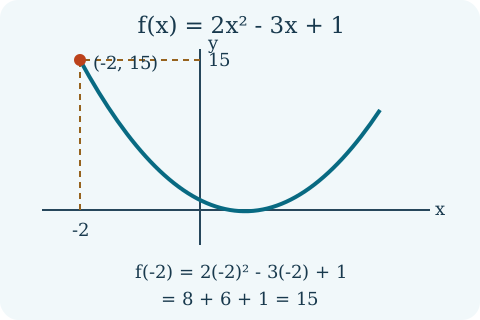
The notation f(t) asks for the output of a rule at the input t; it is not f multiplied by t. Replace each x in ax^2 + bx + c with the same parenthesized value. Compute t^2 first, then a times that square and b times t, and finally add the constant. Parentheses are especially important for a negative input because (-2)^2 is 4, not -4.
The same polynomial can be grouped as (at + b)t + c. This Horner form offers an independent arithmetic route to the same exact result with fewer multiplications. The graph pairs each input with its output; the entered point is (t,f(t)). Zero a produces a line and zero a and b produce a constant function, both valid evaluation tasks.
Worked examples
Read the reasoning, or load an example into the calculator.
A negative input
f(-2) = 2(-2)^2 - 3(-2) + 1 = 8 + 6 + 1 = 15. Horner form gives (-4 - 3)(-2) + 1 = 15.
A fractional input
For f(x) = x^2 + x, f(1/2) = 1/4 + 1/2 = 3/4. Exact fractions avoid rounding the intermediate square.
A constant function
With a = b = 0 and c = -7, every input maps to -7. In particular f(9) = -7 and the graph is horizontal.
Try it without the calculator
Three questions for practice, not a graded school assessment. Your answers stay on this page and are not saved.
Original Testinar learning content. This local preview is awaiting final review before publication.