Grades 8-10Free, no account needed
Two-equation system calculator
Solve ax + by = c and dx + ey = f, with exact intersection coordinates and complete consistency checks.
Try your problem
Supported inputs and limits
Exactly two linear equations in x and y. Each input has magnitude at most 10,000 and reduced numerator/denominator at most 1,000,000. Fractions and base-engine number syntax are exact. Zero rows, identities and contradictions are supported. Paste at most 200 characters: system(1,1,3,1,-1,1), ordered a,b,c,d,e,f; pasted numbers use integers, decimals or integer fractions.
Step by step
Understand the method
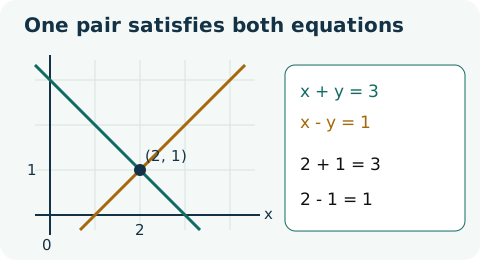
A solution of a two-equation system is an ordered pair that makes both equations true at once. Two nonparallel lines meet at exactly one pair. The determinant D = ae - bd measures whether the two coefficient rows are independent. For nonzero D, x = (ce - bf)/D and y = (af - cd)/D.
A zero determinant calls for a consistency check, not division by zero. Proportional left sides with different right sides cannot hold at once. Proportional complete equations describe infinitely many pairs. Zero coefficient rows need special care: 0x + 0y = 0 adds no restriction, while 0x + 0y = 5 is impossible even if every determinant is zero.
Worked examples
Read the reasoning, or load an example into the calculator.
One intersection
x + y = 3 and x - y = 1 give 2x = 4, so x = 2 and y = 1. Both equations check.
The same line twice
2x + 2y = 6 is twice x + y = 3. Every pair (t, 3 - t) solves both equations.
Parallel distinct lines
Doubling x + y = 3 would give 2x + 2y = 6, not 8. The equations are inconsistent.
Try it without the calculator
Three questions for practice, not a graded school assessment. Your answers stay on this page and are not saved.
Original Testinar learning content. This local preview is awaiting final review before publication.