Grades 7-9Free, no account needed
Linear inequality calculator
Solve ax + b < c, <= c, > c or >= c with exact boundaries and a matching number line.
Try your problem
Supported inputs and limits
One inequality ax + b operator c with operator <, <=, > or >=. Each numeric input has magnitude at most 10,000 and reduced numerator/denominator at most 1,000,000. Zero a gives all or no real solutions. Exact boundary text accompanies approximate display positions. Paste at most 200 characters: inequality(-2,3,<=,7); pasted numbers use integers, decimals or integer fractions.
Step by step
Understand the method
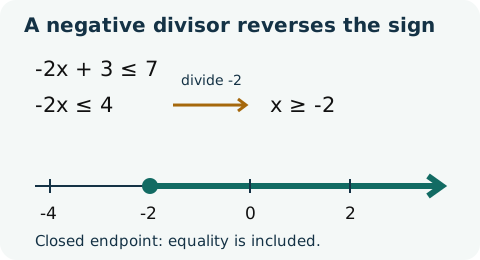
An inequality compares expressions instead of asserting equality. Adding or subtracting the same value on both sides preserves its direction. To isolate x in ax + b < c, first subtract b. Division by a positive coefficient keeps the comparison direction, while division by a negative coefficient reverses it.
A number line displays all real solutions, not just the boundary. Strict comparisons use an open endpoint because equality is excluded; <= and >= use a closed endpoint. If a is zero, there is no variable to isolate: decide whether the remaining constant comparison is true for all x or false for all x.
Worked examples
Read the reasoning, or load an example into the calculator.
Reverse the direction
-2x + 3 <= 7 becomes -2x <= 4. Divide by -2 and reverse: x >= -2, including -2.
A strict upper boundary
3x - 1 < 5 becomes 3x < 6, so x < 2. The boundary 2 is excluded.
No variable restriction
0x + 2 <= 2 reduces to 2 <= 2, which is true for every real x.
Try it without the calculator
Three questions for practice, not a graded school assessment. Your answers stay on this page and are not saved.
Original Testinar learning content. This local preview is awaiting final review before publication.