Grades 4-10Free, no account needed
Exact divisibility and remainder calculator
Decide divisibility by any supported positive integer divisor using exact Euclidean quotient, remainder and reconstruction.
Try your problem
Supported inputs and limits
Dividend: signed decimal integer with 1-30 digits plus optional leading sign. Divisor: positive integer from 1 to 1000000. No decimal/fraction/exponent dividend syntax. Results are exact BigInts and a reduced rational quotient. The number line fits one local divisor interval; symbolic endpoint labels avoid rounding large neighboring integers. Paste divisible(-29;6), at most 200 characters, with semicolon arguments.
Step by step
Understand the method
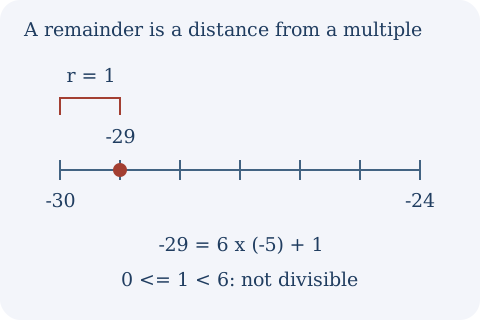
For a positive divisor d, every integer n has a unique Euclidean division n = d*q + r with 0 <= r < d. The integer q is the floor quotient and r is the nonnegative remainder. Divisibility means that r is exactly zero, not merely that a decimal quotient looks almost whole.
Negative dividends still use a nonnegative remainder here. For -29 divided by 6, the multiple at or below -29 is -30 = 6*(-5). The leftover distance is 1, giving q=-5 and r=1. Multiply q by d and add r to check the original number. Zero is divisible by every nonzero integer divisor.
Worked examples
Read the reasoning, or load an example into the calculator.
A negative nonmultiple
-29 = 6*(-5) + 1, with 0 <= 1 < 6. Its Euclidean quotient is -5 and remainder is 1, so it is not divisible by 6.
A large exact multiple
12345678901234567890 = 10*1234567890123456789 + 0. The zero remainder proves divisibility by 10 without converting to floating point.
Zero has no leftover
0 = 7*0 + 0. The quotient and remainder are both zero; a valid positive divisor always divides zero.
Try it without the calculator
Three questions for practice, not a graded school assessment. Your answers stay on this page and are not saved.
Original Testinar learning content. This local preview is awaiting final review before publication.