Grades 6-8Free, no account needed
Parallelogram area & perimeter calculator
Calculate exact base-height area, and optionally perimeter when a consistent sloping side is known. Compare the figure with an equal-area rectangle.
Try your problem
Supported inputs and limits
Modes: area and area-perimeter. Positive active lengths <=10,000 and reduced denominators <=1,000,000; perimeter mode requires height<=side exactly. Inactive side is ignored. Fields accept integers, fractions, mixed/repeating numbers and finite decimals <=9 places under base-engine 40-character/raw limits. Exact rational area/perimeter; approximate projection only for drawing. Units: units, cm, m, in, ft; common units, no conversion. Paste <=200 characters: parallelogram(area,8,3,cm) or parallelogram(area-perimeter,8,3,5,cm). Tokens have no internal spaces or expressions.
Step by step
Understand the method
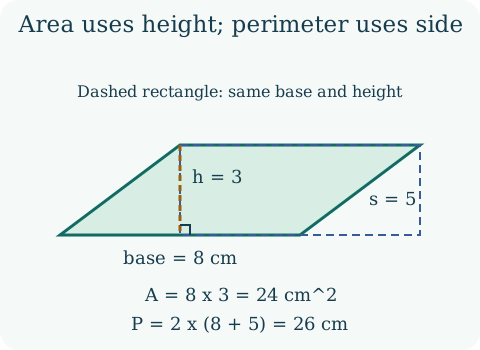
A horizontal shear slides the top of a rectangle without changing its base, height or area. The parallelogram area is therefore base times perpendicular height. The sloping edge is not the height unless it is perpendicular to the base.
Opposite sides are equal, so perimeter is 2*(base+side), where side is the boundary edge adjacent to the base. Base and height alone cannot determine that edge or the perimeter.
A side must be at least as long as its vertical component, the height. If side equals height, the horizontal projection is zero and the representative figure is a rectangle. If side exceeds height, either left-leaning or right-leaning orientations are possible.
Worked examples
Read the reasoning, or load an example into the calculator.
Area and perimeter use different lengths
A = 8*3 = 24 cm^2. The side is 5, not 3, so P = 2*(8+5) = 26 cm. The side's horizontal projection is 4 cm.
Area without a side
A = (5/2)*(3/2) = 15/4 m^2. A sloping side was not supplied, so no unique perimeter is reported.
The rectangle boundary case
Side = height = 2 ft makes the projection zero. Area = 7*2 = 14 ft^2 and perimeter = 2*(7+2) = 18 ft.
Try it without the calculator
Three questions for practice, not a graded school assessment. Your answers stay on this page and are not saved.
Original Testinar learning content. This local preview is awaiting final review before publication.