Grades 6-8Free, no account needed
Trapezoid area calculator
Find exact trapezoid area from two parallel bases and perpendicular height, with a midsegment model and independent area bounds.
Try your problem
Supported inputs and limits
Positive lengths <=10,000; reduced denominators <=1,000,000. Fields accept integers, fractions, mixed numbers, repeating decimals and finite decimals up to 9 places under the base engine's 40-character/raw limits. Exact rational arithmetic; no side or perimeter inference. Units: units, cm, m, in, ft, common to all lengths; no conversion. Thin drawings disclose display resolution. Paste <=200 characters: trapezoid(10,6,4,cm); numeric tokens have no internal spaces or expressions.
Step by step
Understand the method
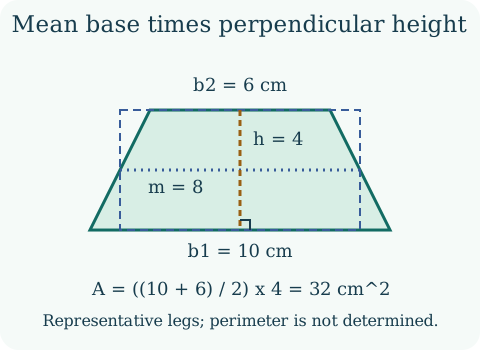
Imagine joining a rotated copy of a trapezoid to the original. The pair fills a parallelogram whose base is the sum of the two parallel bases and whose height is unchanged. Each trapezoid therefore has area (b1+b2)*h/2.
The segment joining the midpoints of the legs is parallel to both bases and has length (b1+b2)/2. A rectangle with this mean-base width and the same height has the same area. The area must lie between shorter-base times height and longer-base times height.
Two bases and a height do not fix the horizontal displacement of the top base. They determine area but not the lengths of the legs or the perimeter. Equal bases are accepted under the inclusive convention: the result is a parallelogram.
Worked examples
Read the reasoning, or load an example into the calculator.
Two unequal bases
Mean base = (10+6)/2 = 8 cm. Multiply by height 4 cm to get 32 cm^2, between 24 and 40 cm^2.
Fractional measurements
The bases sum to 6 m, so their mean is 3 m. Area = 3*(3/2) = 9/2 m^2, exactly.
Equal bases
Equal bases give a parallelogram under the inclusive convention. Area = ((5+5)/2)*2 = 10 in^2; its perimeter is still not known.
Try it without the calculator
Three questions for practice, not a graded school assessment. Your answers stay on this page and are not saved.
Original Testinar learning content. This local preview is awaiting final review before publication.