Grades 7-10Free, no account needed
Similar triangles scale factor calculator
Use known triangle similarity and corresponding sides to find a scale factor and missing side, with optional area and conditional solid-volume factors.
Try your problem
Supported inputs and limits
Known-similar triangles only. Positive entered lengths a,b,c <=10,000; reduced denominators <=1,000,000. Derived side d and scaling factors are not capped. Fields accept base-engine integers, fractions, mixed/repeating numbers and finite decimals <=9 places, <=40 characters/raw limits. Scaling choices: none, area, area-volume; volume is conditional for similar solids only. Exact rational outputs; fitted drawing uses an illustrative shared angle and common scale, with thin-side warnings. Units: units, cm, m, in, ft; no conversion. Paste <=200 characters: similar(3,6,5,area-volume,cm); tokens have no internal spaces or expressions.
Step by step
Understand the method
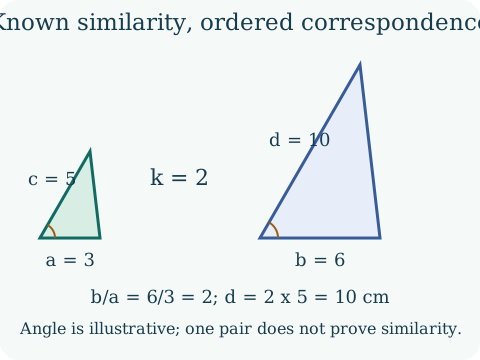
First establish similarity separately, for example by equal corresponding angles. This calculator assumes that similarity and the side correspondence are already known; one matching side ratio cannot prove similarity.
Let source side a correspond to target side b, and source side c correspond to target side d. The target-to-source scale factor is k=b/a. Every corresponding length, including d, is multiplied by k, so d=k*c. Verify the answer with a*d=b*c.
A scale factor above one enlarges; below one reduces. Similar triangle areas multiply by k^2 because both base and height scale. Triangles do not have volume: k^3 is shown only as a conditional extension to similar three-dimensional solids, not as a triangle measurement.
Worked examples
Read the reasoning, or load an example into the calculator.
Enlarge and compare dimensional factors
k = 6/3 = 2, so d = 2*5 = 10 cm. Triangle area scales by 4. Hypothetical similar solid volume would scale by 8; triangles themselves have no volume.
Reduce a figure
k = 2/8 = 1/4, so d = (1/4)*12 = 3 m. The area factor is (1/4)^2 = 1/16, not 1/4.
Keep fractional correspondence exact
k = (9/4)/(3/2) = 3/2. Then d = (3/2)*(5/3) = 5/2 in. Check (3/2)*(5/2) = (9/4)*(5/3) = 15/4.
Try it without the calculator
Three questions for practice, not a graded school assessment. Your answers stay on this page and are not saved.
Original Testinar learning content. This local preview is awaiting final review before publication.