Grades 9-11Free, no account needed
Right-triangle trigonometry calculator
Recover every side and angle of a right triangle from one known side and one acute angle.
Try your problem
Supported inputs and limits
One known side from 1/1000000 through 1000000, in any consistent length unit; angle from 0.1 through 89.9 degrees. Only right triangles are supported. Exact rational input up to 40 characters, nine finite decimal places and reduced denominator <=1000000000. Side expressions are exact; decimal lengths are approximate to 10 significant digits. Very thin triangles are explicitly schematic, not to scale. Paste rightTriangle(hypotenuse,10,30), with side type hypotenuse, adjacent or opposite; at most 200 characters.
Step by step
Understand the method
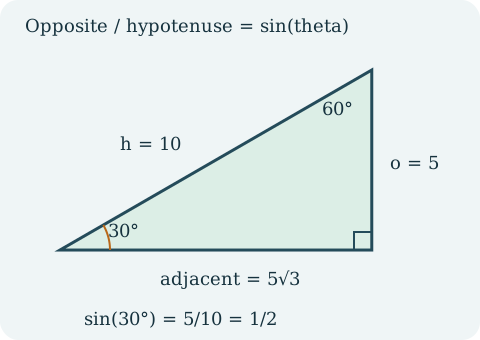
Choose an acute angle before naming the legs. The opposite leg lies across from that angle, and the adjacent leg touches it. The hypotenuse is across from the right angle and is the longest side. The ratios are sin(theta) = opposite/hypotenuse, cos(theta) = adjacent/hypotenuse and tan(theta) = opposite/adjacent.
With the hypotenuse known, multiply it by sine to get the opposite leg and by cosine to get the adjacent leg. With one leg known, divide by its sine or cosine ratio to recover the hypotenuse. The second acute angle is 90 degrees minus the first. Check that the squared legs add to the squared hypotenuse; a side change should scale all lengths without changing the angles.
Worked examples
Read the reasoning, or load an example into the calculator.
Hypotenuse to both legs
For h = 10 and theta = 30 degrees, o = 10 sin(30) = 5 and a = 10 cos(30) = 5 sqrt(3). The other acute angle is 60 degrees.
Adjacent leg to the hypotenuse
With a = 4 and theta = 45 degrees, o = 4 tan(45) = 4 and h = 4/cos(45) = 4 sqrt(2). Both acute angles are 45 degrees.
Opposite leg to the hypotenuse
For o = 3 and theta = 30 degrees, h = 3/sin(30) = 6 and a = 3/tan(30) = 3 sqrt(3). The squared legs sum to 36.
Try it without the calculator
Three questions for practice, not a graded school assessment. Your answers stay on this page and are not saved.
Original Testinar learning content. This local preview is awaiting final review before publication.