Which statement is true about the products of even and odd numbers?
- Even \(\times\) odd is always odd
- Even \(\times\) even is always odd
- Even \(\times\) odd is always even
- Odd \(\times\) odd is always even


Students will identify, extend, and explain arithmetic patterns in addition and multiplication tables.
Which statement is true about the products of even and odd numbers?
Sam skip counts by 3s: 3, 6, 9, 12, \ldots What is the next number in the pattern?
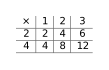
Look at this part of the \(2 \times 2\) multiplication table: Which pattern do you see in the row for 2?
Mia writes this list of odd numbers: 1, 3, 5, 7, 9 What is the next odd number in the pattern?
A toy costs $5. Two toys cost $10. Three toys cost $15. Four toys cost $20. How much do 5 toys cost?
Eli multiplies: \(2 \times 4 = 8\), \(2 \times 6 = 12\), \(2 \times 8 = 16\). Why is every product an even number?
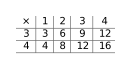
Look at the rows in a multiplication table: What increases by 3 in the row for 3?
Ben multiplies two odd numbers: \(3 \times 5 = 15\). What can you say about the product of two odd numbers?
An even number times any other whole number is always even, because the result is a multiple of \(2\).
Each number increases by 3. Add 3 to 12 to get 15.
The products 2, 4, 6 each increase by 2 because we multiply 2 by 1, then 2, then 3.
Odd numbers go up by 2 each time. Add 2 to 9 to get 11.
The cost goes up by $5 each time. Five toys cost \(5 \times 5 = $25\).
Multiplying any number by 2 gives an even result, because \(2 \times n\) means \(n\) groups of 2, and 2 is even. This pattern always holds: even \(\times\) any number \(=\) even.
In the row for 3, the products are 3, 6, 9, 12, going up by 3 each time.
Odd \(\times\) odd always gives an odd number. For example: \(1 \times 1 = 1\), \(3 \times 3 = 9\), \(5 \times 7 = 35\).
