CH01-09 lesson

Arithmetic Patterns Learning Activity

A focused Grade 3 learning session for Arithmetic Patterns using visual models, worked examples, strategy guidance, and a short mastery check.

15
minutes
6
lesson parts
11
practice items
Learning goal

Students will identify, extend, and explain arithmetic patterns in addition and multiplication tables.

Student goal: I can identify and explain a number pattern.

concept

Learn the Idea

Arithmetic Patterns means choosing a model, naming what each number means, and explaining the strategy.

  • Read the question carefully and identify what is being asked.
  • Choose a model, equation, table, or diagram that matches the situation.
  • Solve one step at a time and keep units or labels attached.
  • Use the answer explanation to check that the result makes sense.
visual model

See the Math

Visual Model 1

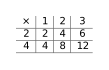
Question: Look at this part of the \(2 \times 2\) multiplication table: Which pattern do you see in the row for 2?

\(\times\)123
2246
44812
  • A. Goes up by 2 each time
  • B. Goes up by 1 each time
  • C. Goes up by 3 each time
  • D. Goes up by 4 each time

Why it works: The products 2, 4, 6 each increase by 2 because we multiply 2 by 1, then 2, then 3.

Answer: Goes up by 2 each time
worked example

Follow a Worked Example

Example 1

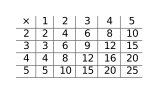
Question: Looking at the number 12 in the table, which multiplications give 12?

\(\times\)12345
2246810
33691215
448121620
5510152025
  • A. Only \(3 \times 4\)
  • B. Only \(4 \times 3\)
  • C. \(3 \times 4\) and \(4 \times 3\)
  • D. \(2 \times 6\) and \(3 \times 4\)
  1. Both give 12.
  2. The multiplication table shows that \(3 \times 4 = 12\) and \(4 \times 3 = 12\).

Answer: \(3 \times 4\) and \(4 \times 3\)

Example 2

Question: Look at a column in the multiplication table: How much does each product increase?

NumberProduct
\(1 \times 6\)6
\(2 \times 6\)12
\(3 \times 6\)18
\(4 \times 6\)24
  • A. By 1
  • B. By 12
  • C. By 4
  • D. By 6
  1. From 6 to 12 is \(+6\); from 12 to 18 is \(+6\); from 18 to 24 is \(+6\).

Answer: By 6

real world

Connect It to a Real Situation

Problem 1

Question: A toy costs $5. Two toys cost $10. Three toys cost $15. Four toys cost $20. How much do 5 toys cost?

  • A. $24
  • B. $30
  • C. $26
  • D. $25

Why it works: The cost goes up by $5 each time. Five toys cost \(5 \times 5 = $25\).

Answer: $25

strategy

Avoid Mistakes and Choose a Strategy

  • Rushing before identifying what the numbers represent.
  • Choosing an operation that does not match the situation.
  • Dropping labels, units, or context from the answer.
  • Skipping the estimate or reasonableness check.
  • Underline the question being asked.
  • Use a model before jumping to computation.
  • Write an equation that matches the story or picture.
  • Explain the final answer in a sentence.
summary

Remember the Key Idea

Arithmetic Patterns becomes easier when students connect the question to a model, use clear steps, and explain why the answer fits.

GOLDEN RULE

Understand the model before choosing the operation.

Guided to independent practice

Solve before opening the answer

Use scratch paper. The explanation matters more than simply seeing whether the choice is correct.

warmup

2 questions
G3-C01-T09-Q001 About 1 min

Which statement is true about the products of even and odd numbers?

  1. A Even \(\times\) odd is always odd
  2. B Even \(\times\) even is always odd
  3. C Even \(\times\) odd is always even
  4. D Odd \(\times\) odd is always even
Check answer and explanation

Answer C: Even \(\times\) odd is always even

An even number times any other whole number is always even, because the result is a multiple of \(2\).

G3-C01-T09-Q002 About 1 min

Sam skip counts by 3s: 3, 6, 9, 12, \ldots What is the next number in the pattern?

  1. A 13
  2. B 14
  3. C 15
  4. D 16
Check answer and explanation

Answer C: 15

Each number increases by 3. Add 3 to 12 to get 15.

guided

1 question
G3-C01-T09-Q003 About 1 min

Look at this part of the \(2 \times 2\) multiplication table: Which pattern do you see in the row for 2?

Arithmetic Patterns visual for G3-C01-T09-Q003
  1. A Goes up by 2 each time
  2. B Goes up by 1 each time
  3. C Goes up by 3 each time
  4. D Goes up by 4 each time
Check answer and explanation

Answer A: Goes up by 2 each time

The products 2, 4, 6 each increase by 2 because we multiply 2 by 1, then 2, then 3.

practice

5 questions
G3-C01-T09-Q004 About 1 min

Mia writes this list of odd numbers: 1, 3, 5, 7, 9 What is the next odd number in the pattern?

  1. A 10
  2. B 13
  3. C 12
  4. D 11
Check answer and explanation

Answer D: 11

Odd numbers go up by 2 each time. Add 2 to 9 to get 11.

G3-C01-T09-Q005 About 1 min

A toy costs $5. Two toys cost $10. Three toys cost $15. Four toys cost $20. How much do 5 toys cost?

  1. A $24
  2. B $30
  3. C $26
  4. D $25
Check answer and explanation

Answer D: $25

The cost goes up by $5 each time. Five toys cost \(5 \times 5 = $25\).

G3-C01-T09-Q006 About 1 min

Eli multiplies: \(2 \times 4 = 8\), \(2 \times 6 = 12\), \(2 \times 8 = 16\). Why is every product an even number?

  1. A Because 2 is an even number
  2. B Because we add the numbers together
  3. C Because all products are less than 20
  4. D Because we are always multiplying by 2, and multiplying by an even number always gives an even product
Check answer and explanation

Answer D: Because we are always multiplying by 2, and multiplying by an even number always gives an even product

Multiplying any number by 2 gives an even result, because \(2 \times n\) means \(n\) groups of 2, and 2 is even. This pattern always holds: even \(\times\) any number \(=\) even.

G3-C01-T09-Q007 About 1 min

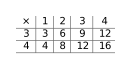
Look at the rows in a multiplication table: What increases by 3 in the row for 3?

Arithmetic Patterns visual for G3-C01-T09-Q007
  1. A The multiplier on the top
  2. B The table title
  3. C The column number
  4. D The product each time
Check answer and explanation

Answer D: The product each time

In the row for 3, the products are 3, 6, 9, 12, going up by 3 each time.

G3-C01-T09-Q008 About 1 min

Which list shows skip counting by 4s?

  1. A 2, 4, 6, 8, 10
  2. B 5, 10, 15, 20, 25
  3. C 3, 6, 9, 12, 15
  4. D 4, 8, 12, 16, 20
Check answer and explanation

Answer D: 4, 8, 12, 16, 20

Skip counting by 4 means adding 4 each time: \(4 + 4 = 8\), \(8 + 4 = 12\), etc.

exit

3 questions
G3-C01-T09-Q009 About 1 min

Ben multiplies two odd numbers: \(3 \times 5 = 15\). What can you say about the product of two odd numbers?

  1. A The product is always even
  2. B The product is always a multiple of 5
  3. C The product is always greater than 10
  4. D The product is always odd
Check answer and explanation

Answer D: The product is always odd

Odd \(\times\) odd always gives an odd number. For example: \(1 \times 1 = 1\), \(3 \times 3 = 9\), \(5 \times 7 = 35\).

G3-C01-T09-Q010 About 1 min

Kai skip counts by 6: 6, 12, 18, 24, 30. Which number should come next?

  1. A 32
  2. B 35
  3. C 36
  4. D 40
Check answer and explanation

Answer C: 36

Add 6 each time: \(30 + 6 = 36\). This is skip counting by 6.

G3-C01-T09-Q011 About 1 min

Looking at the number 12 in the table, which multiplications give 12?

Arithmetic Patterns visual for G3-C01-T09-Q011
  1. A Only \(3 \times 4\)
  2. B Only \(4 \times 3\)
  3. C \(3 \times 4\) and \(4 \times 3\)
  4. D \(2 \times 6\) and \(3 \times 4\)
Check answer and explanation

Answer C: \(3 \times 4\) and \(4 \times 3\)

Both give 12. The multiplication table shows that \(3 \times 4 = 12\) and \(4 \times 3 = 12\).

Page UP