
CH01-07 lesson

Fluently Multiply and Divide Within 100 Learning Activity

A focused Grade 3 learning session for Fluently Multiply and Divide Within 100 using visual models, worked examples, strategy guidance, and a short mastery check.

15
minutes
6
lesson parts
11
practice items
Learning goal

Students will multiply and divide fluently within 100 using accurate and efficient strategies.

Student goal: I can multiply and divide within 100 accurately and efficiently.

concept

Learn the Idea

Fluently Multiply and Divide Within 100 means understanding equal groups, arrays, and repeated addition as multiplication.

  • Name the equal groups before choosing an operation.
  • Use arrays, repeated addition, or related facts to explain the work.
  • Connect multiplication and division as inverse operations.
  • Check that the answer fits the story problem.
visual model

See the Math

Visual Model 1

Question: Look at the skip-count number line. It shows counting by \(3\)s. What number is missing? What is \(3\times3\)?

Grade 3 Fluently Multiply and Divide Within 100 figure 1

  • A. \(6\)
  • B. \(15\)
  • C. \(12\)
  • D. \(9\)

Why it works: Skip-counting by \(3\)s: \(0, 3, 6, 9\). So \(3\times3=9\).

Answer: \(9\)

worked example

Follow a Worked Example

Example 1

Question: Look at the skip-count pattern. What is the rule? What is \(2\times5\)?

Grade 3 Fluently Multiply and Divide Within 100 figure 2

  • A. \(8\)
  • B. \(14\)
  • C. \(12\)
  • D. \(10\)
  1. Skip-counting by \(2\)s: \(0, 2, 4, 6, 8, 10\).
  2. So \(2\times5=10\).

Answer: \(10\)

Example 2

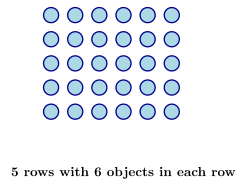
Question: Look at this array. Count the objects.

Grade 3 Fluently Multiply and Divide Within 100 figure 3

  • A. \(25\) objects
  • B. \(28\) objects
  • C. \(30\) objects
  • D. \(36\) objects
  1. There are \(5\) rows with \(6\) objects in each row. \(5\times6=30\) objects in total.

Answer: \(30\) objects

real world

Connect It to a Real Situation

Problem 1

Question: A farmer has \(6\) baskets. Each basket holds \(7\) apples. How many apples does the farmer have?

  • A. \(36\) apples
  • B. \(40\) apples
  • C. \(42\) apples
  • D. \(48\) apples

Why it works: \(6\) baskets with \(7\) apples each: \(6\times7=42\).

Answer: \(42\) apples

strategy

Avoid Mistakes and Choose a Strategy

  • Rushing before identifying what the numbers represent.
  • Choosing an operation that does not match the situation.
  • Dropping labels, units, or context from the answer.
  • Skipping the estimate or reasonableness check.
  • Underline the question being asked.
  • Use a model before jumping to computation.
  • Write an equation that matches the story or picture.
  • Explain the final answer in a sentence.
summary

Remember the Key Idea

Fluently Multiply and Divide Within 100 becomes easier when students connect the question to a model, use clear steps, and explain why the answer fits.

GOLDEN RULE

Equal groups make multiplication make sense.

Guided to independent practice

Solve before opening the answer

Use scratch paper. The explanation matters more than simply seeing whether the choice is correct.

warmup

2 questions
G3-C01-T07-Q001 About 1 min

What is \(7\times9\)?

  1. A \(56\)
  2. B \(63\)
  3. C \(70\)
  4. D \(81\)
Check answer and explanation

Answer B: \(63\)

\(7\times9=63\). Think: \(7\times10=70\), then subtract one group of \(7\): \(70-7=63\). Choice C is \(7\times10\); choice A is \(7\times8\).

G3-C01-T07-Q002 About 1 min

What is \(6\times8\)?

  1. A \(42\)
  2. B \(56\)
  3. C \(54\)
  4. D \(48\)
Check answer and explanation

Answer D: \(48\)

\(6\times8=48\). You can think of \(6\) groups of \(8\), or \(8\) groups of \(6\).

guided

1 question
G3-C01-T07-Q003 About 1 min

What is \(4\times7\)?

  1. A \(28\)
  2. B \(32\)
  3. C \(35\)
  4. D \(39\)
Check answer and explanation

Answer A: \(28\)

\(4\times7=28\). Count by \(7\)s four times: \(7, 14, 21, 28\).

practice

5 questions
G3-C01-T07-Q004 About 1 min

Which equation is true?

  1. A \(3\times6=19\)
  2. B \(9\times3=28\)
  3. C \(8\times5=42\)
  4. D \(5\times6=30\)
Check answer and explanation

Answer D: \(5\times6=30\)

\(5\times6=30\) is correct. The other answers are: \(3\times6=18\), \(8\times5=40\), and \(9\times3=27\).

G3-C01-T07-Q005 About 1 min

What is \(72\div8\)?

  1. A \(8\)
  2. B \(9\)
  3. C \(10\)
  4. D \(64\)
Check answer and explanation

Answer B: \(9\)

\(72\div8=9\) because \(9\times8=72\). Division and multiplication are related. Choice D (\(64\)) is \(8\times8\), a common mistake.

G3-C01-T07-Q006 About 1 min

What is \(5\times9\)?

  1. A \(40\)
  2. B \(54\)
  3. C \(50\)
  4. D \(45\)
Check answer and explanation

Answer D: \(45\)

\(5\times9=45\). Count by \(5\)s: \(5, 10, 15, 20, 25, 30, 35, 40, 45\).

G3-C01-T07-Q007 About 1 min

What is \(32\div4\)?

  1. A \(6\)
  2. B \(7\)
  3. C \(8\)
  4. D \(9\)
Check answer and explanation

Answer C: \(8\)

\(32\div4=8\) because \(8\times4=32\). You need \(4\) groups with \(8\) in each group.

G3-C01-T07-Q008 About 1 min

Look at the fact family for \(3\), \(6\), and \(18\). Which shows TWO correct related facts?

  1. A \(3\times6=18\) and \(6\times3=18\)
  2. B \(3\times6=18\) and \(18\div3=6\)
  3. C \(3\times6=19\) and \(19\div6=3\)
  4. D \(3\times6=20\) and \(20\div3=6\)
Check answer and explanation

Answer B: \(3\times6=18\) and \(18\div3=6\)

The fact family for \(3\), \(6\), and \(18\) includes: \(3\times6=18\), \(6\times3=18\), \(18\div3=6\), and \(18\div6=3\). Choice B shows one multiplication fact and its related division fact.

exit

3 questions
G3-C01-T07-Q009 About 1 min

What is \(9\times4\)?

  1. A \(32\)
  2. B \(35\)
  3. C \(36\)
  4. D \(40\)
Check answer and explanation

Answer C: \(36\)

\(9\times4=36\). You can think of \(4\) nines or \(9\) fours: \(9+9+9+9=36\).

G3-C01-T07-Q010 About 1 min

What is \(56\div7\)?

  1. A \(7\)
  2. B \(10\)
  3. C \(9\)
  4. D \(8\)
Check answer and explanation

Answer D: \(8\)

\(56\div7=8\) because \(8\times7=56\). Seven groups of \(8\) equals \(56\).

G3-C01-T07-Q011 About 1 min

What is \(3\times8\)?

  1. A \(24\)
  2. B \(28\)
  3. C \(30\)
  4. D \(32\)
Check answer and explanation

Answer A: \(24\)

\(3\times8=24\). Think of three groups of \(8\): \(8+8+8=24\).

Page UP