CH01-06 lesson

Division as an Unknown-Factor Problem Learning Activity

A focused Grade 3 learning session for Division as an Unknown-Factor Problem using visual models, worked examples, strategy guidance, and a short mastery check.

15
minutes
6
lesson parts
11
practice items
Learning goal

Students will connect division to multiplication by treating division as an unknown-factor problem.

Student goal: I can use a related multiplication fact to solve a division problem.

concept

Learn the Idea

Division as an Unknown-Factor Problem means choosing a model, naming what each number means, and explaining the strategy.

  • Read the question carefully and identify what is being asked.
  • Choose a model, equation, table, or diagram that matches the situation.
  • Solve one step at a time and keep units or labels attached.
  • Use the answer explanation to check that the result makes sense.
visual model

See the Math

Visual Model 1

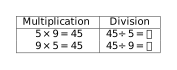
Question: Complete the fact family for 5, 9, and 45: What are the missing numbers?

MultiplicationDivision
\(5\times9=45\)\(45\div5=\square\)
\(9\times5=45\)\(45\div9=\square\)
  • A. 45 and 45
  • B. 4 and 4
  • C. 5 and 9
  • D. 9 and 5

Why it works: In a fact family, \(45\div5=9\) and \(45\div9=5\). Division reverses multiplication.

Answer: 9 and 5

worked example

Follow a Worked Example

Example 1

Question: Look at the fact-family triangle below. If \(4\times6=24\), what is \(24\div4\)?

Grade 3 Division as an Unknown-Factor Problem figure 1

  • A. 4
  • B. 28
  • C. 24
  • D. 6
  1. In a fact-family triangle, the product is at the top and the factors are at the bottom.
  2. If \(4\times6=24\), then \(24\div4=6\).
  3. The factors are the answers when dividing.

Answer: 6

Example 2

Question: Which division equation matches this bar model showing 30 split into 5 equal parts?

Grade 3 Division as an Unknown-Factor Problem figure 2

  • A. \(30\times5=150\)
  • B. \(30-5=25\)
  • C. \(5+6=11\)
  • D. \(30\div5=6\)
  1. A bar model dividing a total into equal parts shows division. 30 split into 5 equal parts means each part is \(30\div5=6\).

Answer: \(30\div5=6\)

real world

Connect It to a Real Situation

Problem 1

Question: Noah has 16 pencils. He puts them into 4 boxes equally. Which division equation shows this?

  • A. \(4\times4=16\)
  • B. \(16+4=20\)
  • C. \(16-4=12\)
  • D. \(16\div4=4\)

Why it works: Dividing 16 pencils into 4 equal boxes means \(16\div4=\square\). Since \(4\times4=16\), each box has 4 pencils.

Answer: \(16\div4=4\)

strategy

Avoid Mistakes and Choose a Strategy

  • Rushing before identifying what the numbers represent.
  • Choosing an operation that does not match the situation.
  • Dropping labels, units, or context from the answer.
  • Skipping the estimate or reasonableness check.
  • Underline the question being asked.
  • Use a model before jumping to computation.
  • Write an equation that matches the story or picture.
  • Explain the final answer in a sentence.
summary

Remember the Key Idea

Division as an Unknown-Factor Problem becomes easier when students connect the question to a model, use clear steps, and explain why the answer fits.

GOLDEN RULE

Understand the model before choosing the operation.

Guided to independent practice

Solve before opening the answer

Use scratch paper. The explanation matters more than simply seeing whether the choice is correct.

warmup

2 questions
G3-C01-T06-Q001 About 1 min

Which multiplication fact helps you solve \(32\div8\)?

  1. A \(4\times8=32\)
  2. B \(5\times8=40\)
  3. C \(8\times8=64\)
  4. D \(3\times8=24\)
Check answer and explanation

Answer A: \(4\times8=32\)

Division is an unknown-factor problem. \(32\div8=\square\) is the same as finding \(\square\times8=32\), which gives \(\square=4\). Distractors B, C, D are off-by-one or incorrect products.

G3-C01-T06-Q002 About 1 min

Ben has 24 crackers to share equally among 6 friends. How many crackers does each friend get?

  1. A 4
  2. B 6
  3. C 3
  4. D 5
Check answer and explanation

Answer A: 4

\(24\div6=\square\) means \(\square\times6=24\). Since \(4\times6=24\), each friend gets 4 crackers. We use a multiplication fact to solve the division problem.

guided

1 question
G3-C01-T06-Q003 About 1 min

Complete the fact family: \(\)5\times7=35 \quad 7\times5=35 \quad 35\div5=\square \quad 35\div7=\square\(\)

  1. A 7 and 5
  2. B 5 and 7
  3. C 35 and 35
  4. D 10 and 10
Check answer and explanation

Answer A: 7 and 5

In a fact family, if \(5\times7=35\), then \(35\div5=7\) (because \(7\times5=35\)) and \(35\div7=5\) (because \(5\times7=35\)). In division, we find the missing factor from the multiplication fact. Options C and D incorrectly repeat the same number.

practice

5 questions
G3-C01-T06-Q004 About 1 min

What is the missing number? \(\square\times8=48\)

  1. A 5
  2. B 8
  3. C 7
  4. D 6
Check answer and explanation

Answer D: 6

Finding the missing factor: \(6\times8=48\). This is the same as asking \(48\div8=\square\). We think: what times 8 makes 48? The answer is 6 because \(6\times8=48\).

G3-C01-T06-Q005 About 1 min

Lily has 20 stickers. She puts them in 4 equal groups. How many stickers are in each group?

  1. A 5
  2. B 4
  3. C 6
  4. D 24
Check answer and explanation

Answer A: 5

\(20\div4=\square\) means \(\square\times4=20\). Since \(5\times4=20\), there are 5 stickers in each group. Option B (confuses divisor with quotient); Option D adds instead of divides.

G3-C01-T06-Q006 About 1 min

Use the multiplication fact \(6\times9=54\) to write a division equation.

  1. A \(54\div6=9\)
  2. B \(54\div9=6\)
  3. C \(9\div6=1\)
  4. D \(54+6=60\)
Check answer and explanation

Answer A: \(54\div6=9\)

From \(6\times9=54\), one related division equation is \(54\div6=9\) (the answer is the factor 9). Option B reverses correctly but is also valid; A is the expected answer. Options C and D use wrong operations.

G3-C01-T06-Q007 About 1 min

Which pair of divisions belongs to the same fact family as \(3\times8=24\)?

  1. A \(24\div3=8\) and \(24\div8=3\)
  2. B \(24\div4=6\) and \(24\div6=4\)
  3. C \(24-3=21\) and \(24-8=16\)
  4. D \(24+3=27\) and \(24+8=32\)
Check answer and explanation

Answer A: \(24\div3=8\) and \(24\div8=3\)

The fact family for \(3\times8=24\) includes the related divisions \(24\div3=8\) and \(24\div8=3\).

G3-C01-T06-Q008 About 1 min

What is \(28\div4\)?

  1. A 6
  2. B 7
  3. C 8
  4. D 4
Check answer and explanation

Answer B: 7

\(28\div4=\square\) means \(\square\times4=28\). Since \(7\times4=28\), the answer is 7. Option A (\(6\times4=24\)) is off-by-one. Option D confuses the divisor with the quotient.

exit

3 questions
G3-C01-T06-Q009 About 1 min

Sam earned 36 points in 6 games. If he earned the same number of points in each game, how many points did he earn per game?

  1. A 5 points
  2. B 8 points
  3. C 7 points
  4. D 6 points
Check answer and explanation

Answer D: 6 points

\(36\div6=\square\) means \(\square\times6=36\). Since \(6\times6=36\), Sam earned 6 points per game.

G3-C01-T06-Q010 About 1 min

Complete the fact family for 5, 9, and 45: What are the missing numbers?

Division as an Unknown-Factor Problem visual for G3-C01-T06-Q010
  1. A 45 and 45
  2. B 4 and 4
  3. C 5 and 9
  4. D 9 and 5
Check answer and explanation

Answer D: 9 and 5

In a fact family, \(45\div5=9\) and \(45\div9=5\). Division reverses multiplication.

G3-C01-T06-Q011 About 1 min

Which multiplication fact helps solve \(42\div7\)?

  1. A \(6\times7=42\)
  2. B \(7\times7=49\)
  3. C \(5\times7=35\)
  4. D \(8\times7=56\)
Check answer and explanation

Answer A: \(6\times7=42\)

To solve \(42\div7=\square\) using the unknown-factor strategy, we ask: \(\square\times7=42\). Since \(6\times7=42\), the missing factor is 6. Options B, C, D produce different products, not 42.

Page UP