What is \(6\times40\)? Show your thinking: \(6\times40 = 6\times(4\times10) = (6\times4)\times10\).
- \(46\)
- \(64\)
- \(240\)
- \(2400\)


Students will multiply one-digit numbers by multiples of 10 using place value and known multiplication facts.
What is \(6\times40\)? Show your thinking: \(6\times40 = 6\times(4\times10) = (6\times4)\times10\).
How many stars are there? Skip count by \(10\)s to find the total.

Which repeated addition matches \(5\times10\)?
Quinn calculated \(7\times30\) and got \(710\). What error did Quinn make?
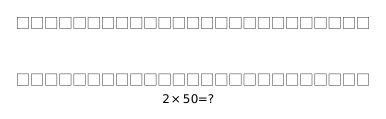
This array has \(2\) rows. Each row has \(50\) squares. How many squares in total?
Which shows why \(4\times20\) equals \(80\)?
Sam has \(8\) groups of \(10\) stickers. How many stickers does Sam have in total?

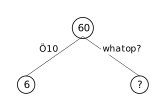
Look at this number bond. What value should replace the question mark?
Multiply \(6\times4=24\), then multiply by \(10\) to get \(240\): \(6\times40 = 24\times10 = 240\). You decompose \(40\) as \(4\times10\), then use the associative property.
Skip count by \(10\)s: \(10, 20, 30\). There are \(3\) groups of \(10\) stars, so \(3\times10=30\) stars total.
\(5\times10\) means \(5\) groups of \(10\), which is the same as adding \(10\) five times: \(10+10+10+10+10=50\). This shows that multiplication is repeated addition.
\(7\times30=210\) (multiply \(7\times3=21\), then multiply by \(10\)). Quinn wrote \(7\) and \(30\) together as \(730\) instead. The correct answer is \(210\).
\(2\) rows of \(50\) squares \(= 2\times50=100\) squares. Multiply \(2\times5=10\), then multiply by \(10\) to get \(100\).
\(4\times20 = 4\times(2\times10) = (4\times2)\times10 = 8\times10 = 80\). This uses associative property: you break \(20\) into \(2\times10\), multiply the single digits first, then multiply by \(10\).
\(8\) groups of \(10 = 8 \times 10 = 80\) stickers. The place-value chart shows 8 tens and 0 ones, which equals 80.
\(60 = 6 \times 10\). The number bond shows that \(60\) can be decomposed into \(6\) and another factor; that factor is \(10\). You multiply \(6\times10\) to get \(60\).
