CH02-03 lesson

Multiplying by Multiples of 10 Learning Activity

A focused Grade 3 learning session for Multiplying by Multiples of 10 using visual models, worked examples, strategy guidance, and a short mastery check.

15
minutes
6
lesson parts
11
practice items
Learning goal

Students will multiply one-digit numbers by multiples of 10 using place value and known multiplication facts.

Student goal: I can multiply a one-digit number by a multiple of 10.

concept

Learn the Idea

Multiplying by Multiples of 10 means understanding equal groups, arrays, and repeated addition as multiplication.

  • Name the equal groups before choosing an operation.
  • Use arrays, repeated addition, or related facts to explain the work.
  • Connect multiplication and division as inverse operations.
  • Check that the answer fits the story problem.
visual model

See the Math

Visual Model 1

Question: How many stars are there? Skip count by \(10\)s to find the total.

Grade 3 Multiplying by Multiples of 10 figure 1

  • A. \(13\)
  • B. \(103\)
  • C. \(31\)
  • D. \(30\)

Why it works: Skip count by \(10\)s: \(10, 20, 30\). There are \(3\) groups of \(10\) stars, so \(3\times10=30\) stars total.

Answer: \(30\)

worked example

Follow a Worked Example

Example 1

Question: Sam has \(8\) groups of \(10\) stickers. How many stickers does Sam have in total?

TensOnes
0800
  • A. \(18\)
  • B. \(108\)
  • C. \(810\)
  • D. \(80\)
  1. \(8\) groups of \(10 = 8 \times 10 = 80\) stickers.
  2. The place-value chart shows 8 tens and 0 ones, which equals 80.

Answer: \(80\)

Example 2

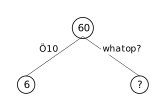
Question: Look at this number bond. What value should replace the question mark?

Grade 3 Multiplying by Multiples of 10 figure 3

  • A. \(6\); divide by \(10\)
  • B. \(600\); multiply by \(10\)
  • C. \(60\); add
  • D. \(10\); multiply
  1. \(60 = 6 \times 10\).
  2. The number bond shows that \(60\) can be decomposed into \(6\) and another factor; that factor is \(10\).
  3. You multiply \(6\times10\) to get \(60\).

Answer: \(10\); multiply

real world

Connect It to a Real Situation

Problem 1

Question: Noah buys \(7\) packs of pencils. Each pack has \(10\) pencils. How many pencils does Noah buy?

  • A. \(17\)
  • B. \(701\)
  • C. \(710\)
  • D. \(70\)

Why it works: \(7\) packs of \(10\) pencils \(= 7 \times 10 = 70\) pencils.

Answer: \(70\)

strategy

Avoid Mistakes and Choose a Strategy

  • Rushing before identifying what the numbers represent.
  • Choosing an operation that does not match the situation.
  • Dropping labels, units, or context from the answer.
  • Skipping the estimate or reasonableness check.
  • Underline the question being asked.
  • Use a model before jumping to computation.
  • Write an equation that matches the story or picture.
  • Explain the final answer in a sentence.
summary

Remember the Key Idea

Multiplying by Multiples of 10 becomes easier when students connect the question to a model, use clear steps, and explain why the answer fits.

GOLDEN RULE

Equal groups make multiplication make sense.

Guided to independent practice

Solve before opening the answer

Use scratch paper. The explanation matters more than simply seeing whether the choice is correct.

warmup

2 questions
G3-C02-T03-Q001 About 1 min

What is \(6\times40\)? Show your thinking: \(6\times40 = 6\times(4\times10) = (6\times4)\times10\).

  1. A \(46\)
  2. B \(64\)
  3. C \(240\)
  4. D \(2400\)
Check answer and explanation

Answer C: \(240\)

Multiply \(6\times4=24\), then multiply by \(10\) to get \(240\): \(6\times40 = 24\times10 = 240\). You decompose \(40\) as \(4\times10\), then use the associative property.

G3-C02-T03-Q002 About 1 min

How many stars are there? Skip count by \(10\)s to find the total.

Multiplying by Multiples of 10 visual for G3-C02-T03-Q002
  1. A \(13\)
  2. B \(103\)
  3. C \(31\)
  4. D \(30\)
Check answer and explanation

Answer D: \(30\)

Skip count by \(10\)s: \(10, 20, 30\). There are \(3\) groups of \(10\) stars, so \(3\times10=30\) stars total.

guided

1 question
G3-C02-T03-Q003 About 1 min

Which repeated addition matches \(5\times10\)?

  1. A \(5+5+5\)
  2. B \(10+5\)
  3. C \(10+10+10+10+10\)
  4. D \(5+10\)
Check answer and explanation

Answer C: \(10+10+10+10+10\)

\(5\times10\) means \(5\) groups of \(10\), which is the same as adding \(10\) five times: \(10+10+10+10+10=50\). This shows that multiplication is repeated addition.

practice

5 questions
G3-C02-T03-Q004 About 1 min

Quinn calculated \(7\times30\) and got \(710\). What error did Quinn make?

  1. A Quinn forgot to multiply at all.
  2. B Quinn wrote the zero in the wrong place.
  3. C Quinn multiplied correctly but added an extra zero.
  4. D Quinn wrote down the digits \(7\) and \(30\) instead of multiplying them.
Check answer and explanation

Answer D: Quinn wrote down the digits \(7\) and \(30\) instead of multiplying them.

\(7\times30=210\) (multiply \(7\times3=21\), then multiply by \(10\)). Quinn wrote \(7\) and \(30\) together as \(730\) instead. The correct answer is \(210\).

G3-C02-T03-Q005 About 1 min

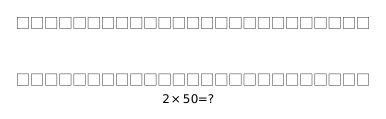
This array has \(2\) rows. Each row has \(50\) squares. How many squares in total?

Multiplying by Multiples of 10 visual for G3-C02-T03-Q005
  1. A \(52\)
  2. B \(25\)
  3. C \(100\)
  4. D \(1000\)
Check answer and explanation

Answer C: \(100\)

\(2\) rows of \(50\) squares \(= 2\times50=100\) squares. Multiply \(2\times5=10\), then multiply by \(10\) to get \(100\).

G3-C02-T03-Q006 About 1 min

Which shows why \(4\times20\) equals \(80\)?

  1. A \((4+2) \times 10 = 60\)
  2. B \(4 + 2 + 10 = 16\)
  3. C \(4 \times (2+10) = 48\)
  4. D \((4\times2) \times 10 = 8 \times 10 = 80\)
Check answer and explanation

Answer D: \((4\times2) \times 10 = 8 \times 10 = 80\)

\(4\times20 = 4\times(2\times10) = (4\times2)\times10 = 8\times10 = 80\). This uses associative property: you break \(20\) into \(2\times10\), multiply the single digits first, then multiply by \(10\).

G3-C02-T03-Q007 About 1 min

Sam has \(8\) groups of \(10\) stickers. How many stickers does Sam have in total?

Multiplying by Multiples of 10 visual for G3-C02-T03-Q007
  1. A \(18\)
  2. B \(108\)
  3. C \(810\)
  4. D \(80\)
Check answer and explanation

Answer D: \(80\)

\(8\) groups of \(10 = 8 \times 10 = 80\) stickers. The place-value chart shows 8 tens and 0 ones, which equals 80.

G3-C02-T03-Q008 About 1 min

What is \(9\times30\)?

  1. A \(27\) (forgot to add zero)
  2. B \(2700\) (added two zeros)
  3. C \(270\)
  4. D \(39\) (added instead of multiplying)
Check answer and explanation

Answer C: \(270\)

Multiply \(9\times3=27\), then multiply by \(10\): \(9\times30=270\). Add exactly one zero—not zero zeros, and not two zeros.

exit

3 questions
G3-C02-T03-Q009 About 1 min

Look at this number bond. What value should replace the question mark?

Multiplying by Multiples of 10 visual for G3-C02-T03-Q009
  1. A \(6\); divide by \(10\)
  2. B \(600\); multiply by \(10\)
  3. C \(60\); add
  4. D \(10\); multiply
Check answer and explanation

Answer D: \(10\); multiply

\(60 = 6 \times 10\). The number bond shows that \(60\) can be decomposed into \(6\) and another factor; that factor is \(10\). You multiply \(6\times10\) to get \(60\).

G3-C02-T03-Q010 About 1 min

Ava makes \(5\) sets of picture cards. Each set has \(20\) cards. How many cards does Ava make?

  1. A \(25\)
  2. B \(52\)
  3. C \(100\)
  4. D \(1000\)
Check answer and explanation

Answer C: \(100\)

\(5\) sets of \(20\) cards \(= 5 \times 20 = 100\) cards. Multiply \(5\times2=10\), then add one zero.

G3-C02-T03-Q011 About 1 min

Look at this pattern: \(3\times10=30\), \(3\times20=60\), \(3\times30=90\). Using the pattern, what is \(3\times70\)?

  1. A \(37\)
  2. B \(73\)
  3. C \(210\)
  4. D \(2100\)
Check answer and explanation

Answer C: \(210\)

The pattern shows: each time we multiply by a multiple of 10 that is 10 more, the product increases by 30. From \(3\times60=180\) to \(3\times70\), we add another 30 to get \(210\). Or: \(3\times7=21\), then multiply by \(10\) to get \(210\).

Page UP