What is \(367\) rounded to the nearest \(100\)?
- \(300\)
- \(370\)
- \(400\)
- \(360\)


Students will use place-value reasoning to round whole numbers to the nearest 10 or 100.
What is \(367\) rounded to the nearest \(100\)?
When you round \(45\) to the nearest \(10\), why does the ones digit matter more than the hundreds digit?
For a number like \(\_\_\_\), the rounding rule says "look at the tens digit." What does the rounding rule mean by "look"?
Two students round differently. Maria says \(127\) rounds to \(130\) (nearest \(10\)). Josh says \(127\) rounds to \(100\) (nearest \(100\)). Are both students correct? Explain.
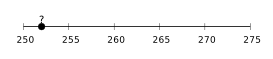
Look at the number line. The number marked \(?\) is closest to which value when rounded to the nearest \(10\)?
Round \(589\) to the nearest \(100\).
Round \(476\) to the nearest \(100\).
What is \(145\) rounded to the nearest \(100\)?
For \(367\), look at the tens digit (\(6\)). Since \(6\geq5\), round the hundreds digit up: \(367\) rounds to \(400\).
When rounding to the nearest \(10\), we look at the ones digit to decide if we round up or down. The ones digit is \(5\), so \(45\) rounds to \(50\).
In rounding, "look at the digit" means check its value to apply the rule: if it's \(5\) or more, round up; if less than \(5\), round down.
For \(127\): to the nearest \(10\), look at the ones digit (\(7\geq5\)), so it rounds to \(130\). To the nearest \(100\), look at the tens digit (\(2<5\)), so it rounds to \(100\). Both answers are correct for their respective place values.
The point is between \(250\) and \(255\), closer to \(250\). A number like \(251\)--\(254\) rounds to \(250\) (ones digit \(<5\)).
The tens digit is \(8\). Since \(8\geq5\), round up: \(589\) rounds to \(600\).
The tens digit is \(7\). Since \(7\geq5\), round up: \(476\) rounds to \(500\).
The tens digit is \(4\). Since \(4<5\), round down: \(145\) rounds to \(100\).
