What is \(\frac{3}{8}+\frac{2}{8}\)?
- \(\frac{1}{8}\)
- \(\frac{5}{8}\)
- \(\frac{5}{16}\)
- \(\frac{6}{8}\)


Students will add and subtract fractions with like denominators by combining or separating equal-sized parts.
What is \(\frac{3}{8}+\frac{2}{8}\)?
Sam ate \(\frac{2}{6}\) of a pizza and Ming ate \(\frac{3}{6}\) of the same pizza. How much of the pizza did they eat together?
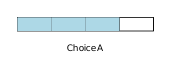
The fraction bar below shows \(\frac{1}{4}+\frac{2}{4}\). Which description matches it?
What is \(\frac{4}{10}+\frac{5}{10}\)?
Ava has \(\frac{2}{5}\) of a candy bar. Diego gives her \(\frac{2}{5}\) more. How much candy does Ava have now?
What is \(\frac{5}{6}-\frac{2}{6}\)?
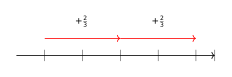
A number line shows hops from 0 to \(\frac{2}{3}\), then another hop to \(\frac{4}{3}\). What operation does this show?
Mia jogged \(\frac{3}{8}\) of a mile. Then she jogged \(\frac{4}{8}\) more. How far did she jog in total?
Same denominator means we just combine numerators: \(3 + 2 = 5\), so \(\mathbf{\frac{5}{8}}\).
Sam and Ming both ate pieces with the same-sized slices. Together: \(2 + 3 = 5\) slices, so \(\mathbf{\frac{5}{6}}\) of the pizza.
The bar shows 4 equal parts. One part shaded for \(\frac{1}{4}\), then 2 more shaded for \(\frac{2}{4}\). That makes 3 shaded parts: \(\mathbf{\frac{3}{4}}\).
Same denominator, same rule: add the numerators (\(4 + 5 = 9\)), keep the denominator. Answer: \(\mathbf{\frac{9}{10}}\).
Ava starts with \(\frac{2}{5}\) and Diego adds \(\frac{2}{5}\) more. With the same-size fifths, we get \(2 + 2 = 4\) fifths: \(\mathbf{\frac{4}{5}}\).
Same denominator for subtraction too! Just subtract numerators: \(5 - 2 = 3\), keep the denominator. Result: \(\mathbf{\frac{3}{6}}\).
The number line starts at 0, hops right by \(\frac{2}{3}\), then hops right by \(\frac{2}{3}\) again, landing at \(\frac{4}{3}\). That's \(\frac{2}{3}+\frac{2}{3}=\frac{4}{3}\).
Mia jogged two sections: \(\frac{3}{8}\) and then \(\frac{4}{8}\) more. Combining same-size eighths: \(3 + 4 = 7\), so \(\mathbf{\frac{7}{8}}\) mile.
