CH04-02 lesson

Adding and Subtracting Fractions with Like Denominators Learning Activity

A focused Grade 4 learning session for Adding and Subtracting Fractions with Like Denominators using visual models, worked examples, strategy guidance, and a short mastery check.

15
minutes
6
lesson parts
11
practice items
Learning goal

Students will add and subtract fractions with like denominators by combining or separating equal-sized parts.

Student goal: I can add and subtract fractions with the same denominator.

concept

Learn the Idea

Adding and Subtracting Fractions with Like Denominators means using equal parts, number lines, and clear fraction language to describe parts of a whole.

  • Identify the whole before naming a fraction.
  • Make sure each part is equal in size.
  • Use a number line or model to show where the fraction belongs.
  • Explain whether two fractions have the same size or different sizes.
visual model

See the Math

Visual Model 1

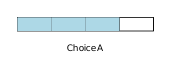
Question: The fraction bar below shows \(\frac{1}{4}+\frac{2}{4}\). Which description matches it?

Visual Model 1

  • A. Shows 3 shaded parts out of 4
  • B. Shows 2 shaded parts out of 8
  • C. Shows 3 shaded parts out of 3
  • D. Shows 1 shaded part out of 4

Why it works: The bar shows 4 equal parts. One part shaded for \(\frac{1}{4}\), then 2 more shaded for \(\frac{2}{4}\). That makes 3 shaded parts: \(\mathbf{\frac{3}{4}}\).

Answer: Shows \(\frac{3}{4}\)

worked example

Follow a Worked Example

Example 1

Question: Which number line shows \(\frac{3}{4}+\frac{1}{4}=1\)?

Example 1

  • A. Starts at 0, hops to \(\frac{1}{2}\)
  • B. Starts at 0, hops to \(\frac{3}{4}\), then to 1
  • C. Starts at \(\frac{1}{4}\), hops to 1
  • D. Starts at \(\frac{1}{2}\), hops to 1
  1. Starting at 0, the first hop goes right by \(\frac{3}{4}\).
  2. The second hop adds \(\frac{1}{4}\) more, landing exactly at \(1\).
  3. That's \(\frac{3}{4}+\frac{1}{4}=1\).

Answer: Starts at 0, hops to \(\frac{3}{4}\), then to 1

Example 2

Question: What is \(\frac{3}{2}-\frac{1}{2}\)?

Example 2

  • A. \(\frac{2}{4}\)
  • B. \(\frac{2}{2}\) or \(1\)
  • C. \(\frac{1}{2}\)
  • D. \(\frac{4}{2}\)
  1. Start with \(\frac{3}{2}\) halves.
  2. Take away \(\frac{1}{2}\): \(3 - 1 = 2\) halves, which equals \(\mathbf{1}\) whole.

Answer: \(1\)

real world

Connect It to a Real Situation

Problem 1

Question: Ming has a ribbon that is \(\frac{5}{8}\) meter long. She cuts off \(\frac{3}{8}\) meter. How much ribbon remains?

  • A. \(\frac{2}{8}\) meter
  • B. \(\frac{8}{16}\) meter
  • C. \(\frac{3}{8}\) meter
  • D. \(\frac{8}{8}\) meter

Why it works: Ming's ribbon started at \(\frac{5}{8}\) meter. She cut off \(\frac{3}{8}\) meter, leaving \(5 - 3 = 2\) eighths: \(\mathbf{\frac{2}{8}}\) meter.

Answer: \(\frac{2}{8}\) meter

strategy

Avoid Mistakes and Choose a Strategy

  • Counting unequal parts as if they were equal.
  • Forgetting that the denominator tells how many equal parts make the whole.
  • Comparing fractions without first checking the size of the whole.
  • Placing a fraction on a number line without counting equal intervals.
  • Draw the whole first, then divide it into equal parts.
  • Use number lines when the question asks about order or location.
  • Say the fraction out loud to connect numerator and denominator meanings.
  • Check whether the answer should be closer to 0, 1/2, or 1.
summary

Remember the Key Idea

Adding and Subtracting Fractions with Like Denominators becomes easier when students connect the question to a model, use clear steps, and explain why the answer fits.

GOLDEN RULE

Equal parts first, fraction name second.

Guided to independent practice

Solve before opening the answer

Use scratch paper. The explanation matters more than simply seeing whether the choice is correct.

warmup

2 questions
G4-C04-T02-Q001 About 1 min

What is \(\frac{3}{8}+\frac{2}{8}\)?

  1. A \(\frac{1}{8}\)
  2. B \(\frac{5}{8}\)
  3. C \(\frac{5}{16}\)
  4. D \(\frac{6}{8}\)
Check answer and explanation

Answer B: \(\frac{5}{8}\)

Same denominator means we just combine numerators: \(3 + 2 = 5\), so \(\mathbf{\frac{5}{8}}\).

G4-C04-T02-Q002 About 1 min

Sam ate \(\frac{2}{6}\) of a pizza and Ming ate \(\frac{3}{6}\) of the same pizza. How much of the pizza did they eat together?

  1. A \(\frac{5}{6}\)
  2. B \(\frac{5}{12}\)
  3. C \(\frac{1}{6}\)
  4. D \(\frac{6}{6}\)
Check answer and explanation

Answer A: \(\frac{5}{6}\)

Sam and Ming both ate pieces with the same-sized slices. Together: \(2 + 3 = 5\) slices, so \(\mathbf{\frac{5}{6}}\) of the pizza.

guided

1 question
G4-C04-T02-Q003 About 1 min

The fraction bar below shows \(\frac{1}{4}+\frac{2}{4}\). Which description matches it?

Adding and Subtracting Fractions with Like Denominators visual for G4-C04-T02-Q003
  1. A Shows 3 shaded parts out of 4
  2. B Shows 2 shaded parts out of 8
  3. C Shows 3 shaded parts out of 3
  4. D Shows 1 shaded part out of 4
Check answer and explanation

Answer A: Shows 3 shaded parts out of 4

The bar shows 4 equal parts. One part shaded for \(\frac{1}{4}\), then 2 more shaded for \(\frac{2}{4}\). That makes 3 shaded parts: \(\mathbf{\frac{3}{4}}\).

practice

5 questions
G4-C04-T02-Q004 About 1 min

What is \(\frac{4}{10}+\frac{5}{10}\)?

  1. A \(\frac{9}{20}\)
  2. B \(\frac{9}{10}\)
  3. C \(\frac{1}{10}\)
  4. D \(1\frac{0}{10}\)
Check answer and explanation

Answer B: \(\frac{9}{10}\)

Same denominator, same rule: add the numerators (\(4 + 5 = 9\)), keep the denominator. Answer: \(\mathbf{\frac{9}{10}}\).

G4-C04-T02-Q005 About 1 min

Ava has \(\frac{2}{5}\) of a candy bar. Diego gives her \(\frac{2}{5}\) more. How much candy does Ava have now?

  1. A \(\frac{4}{10}\)
  2. B \(\frac{4}{5}\)
  3. C \(1\frac{1}{5}\)
  4. D \(\frac{2}{10}\)
Check answer and explanation

Answer B: \(\frac{4}{5}\)

Ava starts with \(\frac{2}{5}\) and Diego adds \(\frac{2}{5}\) more. With the same-size fifths, we get \(2 + 2 = 4\) fifths: \(\mathbf{\frac{4}{5}}\).

G4-C04-T02-Q006 About 1 min

What is \(\frac{5}{6}-\frac{2}{6}\)?

  1. A \(\frac{3}{6}\)
  2. B \(\frac{7}{6}\)
  3. C \(\frac{2}{6}\)
  4. D \(\frac{3}{12}\)
Check answer and explanation

Answer A: \(\frac{3}{6}\)

Same denominator for subtraction too! Just subtract numerators: \(5 - 2 = 3\), keep the denominator. Result: \(\mathbf{\frac{3}{6}}\).

G4-C04-T02-Q007 About 1 min

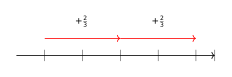
A number line shows hops from 0 to \(\frac{2}{3}\), then another hop to \(\frac{4}{3}\). What operation does this show?

Adding and Subtracting Fractions with Like Denominators visual for G4-C04-T02-Q007
  1. A \(\frac{2}{3}+\frac{2}{3}\)
  2. B \(\frac{1}{3}+\frac{1}{3}\)
  3. C \(\frac{3}{3}-\frac{1}{3}\)
  4. D \(\frac{4}{3}-\frac{1}{3}\)
Check answer and explanation

Answer A: \(\frac{2}{3}+\frac{2}{3}\)

The number line starts at 0, hops right by \(\frac{2}{3}\), then hops right by \(\frac{2}{3}\) again, landing at \(\frac{4}{3}\). That's \(\frac{2}{3}+\frac{2}{3}=\frac{4}{3}\).

G4-C04-T02-Q008 About 1 min

What is \(\frac{1}{4}+\frac{3}{4}\)?

  1. A \(\frac{4}{8}\)
  2. B \(\frac{4}{4}\) or \(1\)
  3. C \(\frac{3}{4}\)
  4. D \(\frac{1}{8}\)
Check answer and explanation

Answer B: \(\frac{4}{4}\) or \(1\)

Add numerators: \(1 + 3 = 4\). We get \(\frac{4}{4}\), which is one whole. When the top and bottom match, it equals \(\mathbf{1}\).

exit

3 questions
G4-C04-T02-Q009 About 1 min

Mia jogged \(\frac{3}{8}\) of a mile. Then she jogged \(\frac{4}{8}\) more. How far did she jog in total?

  1. A \(\frac{7}{8}\) mile
  2. B \(\frac{7}{16}\) mile
  3. C \(1\frac{1}{8}\) miles
  4. D \(\frac{1}{8}\) mile
Check answer and explanation

Answer A: \(\frac{7}{8}\) mile

Mia jogged two sections: \(\frac{3}{8}\) and then \(\frac{4}{8}\) more. Combining same-size eighths: \(3 + 4 = 7\), so \(\mathbf{\frac{7}{8}}\) mile.

G4-C04-T02-Q010 About 1 min

Which expression equals \(1\)?

  1. A \(\frac{2}{5}+\frac{2}{5}\)
  2. B \(\frac{2}{3}+\frac{2}{3}\)
  3. C \(\frac{5}{6}+\frac{1}{6}\)
  4. D \(\frac{3}{4}+\frac{2}{4}\)
Check answer and explanation

Answer C: \(\frac{5}{6}+\frac{1}{6}\)

Check each: A equals \(\frac{4}{5}\) (less), B equals \(\frac{4}{3}\) (more), C equals \(\mathbf{1}\), D equals \(\frac{5}{4}\) (more). Only C = \(\frac{5}{6}+\frac{1}{6}=1\).

G4-C04-T02-Q011 About 1 min

What is \(\frac{7}{10}-\frac{3}{10}\)?

  1. A \(\frac{4}{20}\)
  2. B \(\frac{4}{10}\)
  3. C \(\frac{10}{10}\)
  4. D \(\frac{3}{10}\)
Check answer and explanation

Answer B: \(\frac{4}{10}\)

Subtraction with same denominator: \(7 - 3 = 4\), keep the denominator. Answer: \(\mathbf{\frac{4}{10}}\).

Page UP