CH06-03 lesson

Comparing Decimals Learning Activity

A focused Grade 4 learning session for Comparing Decimals using visual models, worked examples, strategy guidance, and a short mastery check.

15
minutes
6
lesson parts
11
practice items
Learning goal

Students will compare decimals to the hundredths place using place value, models, and comparison symbols.

Student goal: I can compare decimals to the hundredths place and justify my answer.

concept

Learn the Idea

Comparing Decimals means choosing a model, naming what each number means, and explaining the strategy.

  • Read the question carefully and identify what is being asked.
  • Choose a model, equation, table, or diagram that matches the situation.
  • Solve one step at a time and keep units or labels attached.
  • Use the answer explanation to check that the result makes sense.
visual model

See the Math

Visual Model 1

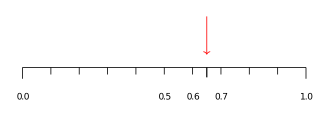
Question: Look at the number line below. What decimal is shown by the arrow?

Visual Model 1

  • A. \(0.6\)
  • B. \(0.65\)
  • C. \(0.56\)
  • D. \(0.68\)

Why it works: The arrow points exactly halfway between \(0.6\) and \(0.7\). The midpoint is \(0.65\).

Answer: \(0.65\)

worked example

Follow a Worked Example

Example 1

Question: Look at the place-value table below. What decimal has \(6\) tenths and \(2\) hundredths?

TenthsHundredthsDecimal
\(6\)\(0\)\(0.60\)
\(6\)\(2\)?
  • A. \(0.26\)
  • B. \(0.62\)
  • C. \(0.206\)
  • D. \(6.02\)
  1. From the table: \(6\) tenths \(= 0.6\) and \(2\) hundredths \(= 0.02\).
  2. Add them: \(0.6 + 0.02 = 0.62\).

Answer: \(0.62\)

Example 2

Question: Look at the number line. What decimal is marked by the dot?

Example 2

  • A. \(0.38\)
  • B. \(0.8\)
  • C. \(0.3\)
  • D. \(0.83\)
  1. This number line zooms in from \(0.30\) to \(0.40\), counting by hundredths.
  2. The dot lands on \(0.38\).

Answer: \(0.38\)

real world

Connect It to a Real Situation

Problem 1

Question: Kai is at a lemonade stand. Pitcher A holds \(0.75\) liters. Pitcher B holds \(0.57\) liters. Which pitcher holds more lemonade?

  • A. Pitcher A (\(0.75\) L)
  • B. Pitcher B (\(0.57\) L)
  • C. Both hold the same amount
  • D. Pitcher B holds twice as much

Why it works: Compare the tenths place: \(7 > 5\), so \(0.75 > 0.57\). Pitcher A holds more lemonade.

Answer: Pitcher A holds more at \(0.75\) liters

strategy

Avoid Mistakes and Choose a Strategy

  • Rushing before identifying what the numbers represent.
  • Choosing an operation that does not match the situation.
  • Dropping labels, units, or context from the answer.
  • Skipping the estimate or reasonableness check.
  • Underline the question being asked.
  • Use a model before jumping to computation.
  • Write an equation that matches the story or picture.
  • Explain the final answer in a sentence.
summary

Remember the Key Idea

Comparing Decimals becomes easier when students connect the question to a model, use clear steps, and explain why the answer fits.

GOLDEN RULE

Understand the model before choosing the operation.

Guided to independent practice

Solve before opening the answer

Use scratch paper. The explanation matters more than simply seeing whether the choice is correct.

warmup

2 questions
G4-C06-T03-Q001 About 1 min

Which comparison is true?

  1. A \(0.6<0.59\)
  2. B \(0.6=0.59\)
  3. C \(0.6>0.59\)
  4. D \(0.6<0.5\)
Check answer and explanation

Answer C: \(0.6>0.59\)

Compare place by place: Write \(0.6\) as \(0.60\). Now both have the same number of decimal places. Since \(60 > 59\) hundredths, we have \(0.6 > 0.59\).

G4-C06-T03-Q002 About 1 min

Which decimal is the smallest?

  1. A \(0.35\)
  2. B \(0.53\)
  3. C \(0.50\)
  4. D \(0.55\)
Check answer and explanation

Answer A: \(0.35\)

When comparing decimals, look at the tenths place first---it has the most weight. \(0.35\) has \(3\) tenths; the others (\(0.53, 0.50, 0.55\)) all have \(5\) tenths. Since \(3 < 5\), the number with fewer tenths is automatically the smallest, no matter what's in the hundredths place. So \(\mathbf{0.35}\) is the smallest. \checkmark

guided

1 question
G4-C06-T03-Q003 About 1 min

How does \(0.4\) compare to \(0.40\)?

  1. A \(0.4<0.40\)
  2. B \(0.4>0.40\)
  3. C \(0.4=0.40\)
  4. D \(0.4=0.04\)
Check answer and explanation

Answer C: \(0.4=0.40\)

A trailing zero doesn't change the value. Both \(0.4\) and \(0.40\) represent the same amount: \(4\) tenths, or \(40\) hundredths.

practice

5 questions
G4-C06-T03-Q004 About 1 min

Order these decimals from least to greatest: \(0.72\), \(0.27\), \(0.70\), \(0.07\).

  1. A \(0.07, 0.27, 0.70, 0.72\)
  2. B \(0.72, 0.70, 0.27, 0.07\)
  3. C \(0.27, 0.07, 0.70, 0.72\)
  4. D \(0.07, 0.70, 0.27, 0.72\)
Check answer and explanation

Answer A: \(0.07, 0.27, 0.70, 0.72\)

Compare the tenths place first: \(0 < 2 < 7\). For the two decimals with tenths \(= 7\), compare hundredths: \(0 < 2\), so \(0.70 < 0.72\).

G4-C06-T03-Q005 About 1 min

Look at the number line below. What decimal is shown by the arrow?

Comparing Decimals visual for G4-C06-T03-Q005
  1. A \(0.6\)
  2. B \(0.65\)
  3. C \(0.56\)
  4. D \(0.68\)
Check answer and explanation

Answer B: \(0.65\)

The arrow points exactly halfway between \(0.6\) and \(0.7\). The midpoint is \(0.65\).

G4-C06-T03-Q006 About 1 min

Which shows the correct comparison?

  1. A \(0.8>0.81\)
  2. B \(0.8<0.81\)
  3. C \(0.81<0.8\)
  4. D \(0.81=0.8\)
Check answer and explanation

Answer B: \(0.8<0.81\)

Rewrite \(0.8\) as \(0.80\) to see it clearly. Comparing: \(80 < 81\) hundredths, so \(0.8 < 0.81\).

G4-C06-T03-Q007 About 1 min

Which decimal is greatest?

  1. A \(0.48\)
  2. B \(0.84\)
  3. C \(0.44\)
  4. D \(0.41\)
Check answer and explanation

Answer B: \(0.84\)

Look at the tenths place: \(0.84\) has \(8\) tenths while the others have \(4\) tenths. Since \(8 > 4\), \(0.84\) is the largest.

G4-C06-T03-Q008 About 1 min

Ava is comparing two running times. Her first race was \(0.55\) seconds and her second race was \(0.50\) seconds. Which time was faster?

  1. A \(0.55\) seconds (first race)
  2. B \(0.50\) seconds (second race)
  3. C Both are the same
  4. D Cannot tell from the information
Check answer and explanation

Answer B: \(0.50\) seconds (second race)

Smaller numbers are faster! Since \(0.50 < 0.55\), the second race at \(0.50\) seconds is the faster time.

exit

3 questions
G4-C06-T03-Q009 About 1 min

What is the correct way to order \(0.91\), \(0.19\), \(0.99\), and \(0.11\) from greatest to least?

  1. A \(0.99, 0.91, 0.19, 0.11\)
  2. B \(0.91, 0.99, 0.11, 0.19\)
  3. C \(0.11, 0.19, 0.91, 0.99\)
  4. D \(0.99, 0.91, 0.11, 0.19\)
Check answer and explanation

Answer A: \(0.99, 0.91, 0.19, 0.11\)

Start with tenths: \(9 > 1\). Among the two with tenths \(= 9\), compare hundredths: \(9 > 1\), so \(0.99 > 0.91\). Among the two with tenths \(= 1\), compare hundredths: \(9 > 1\), so \(0.19 > 0.11\).

G4-C06-T03-Q010 About 1 min

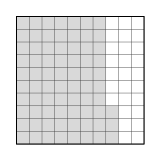
Look at the grid below with hundredths shaded. What decimal is shown?

Comparing Decimals visual for G4-C06-T03-Q010
  1. A \(0.62\)
  2. B \(0.72\)
  3. C \(0.73\)
  4. D \(0.82\)
Check answer and explanation

Answer C: \(0.73\)

Count the shaded squares: \(7\) full columns (that's \(70\) squares) plus \(3\) extra squares make \(73\) squares total. So the decimal is \(73\) hundredths \(= 0.73\).

G4-C06-T03-Q011 About 1 min

Which decimal is between \(0.3\) and \(0.4\)?

  1. A \(0.25\)
  2. B \(0.35\)
  3. C \(0.45\)
  4. D \(0.05\)
Check answer and explanation

Answer B: \(0.35\)

\(0.35\) fits perfectly between \(0.3\) and \(0.4\). The other options fall outside this range.

Page UP