Which comparison is true?
- \(0.6<0.59\)
- \(0.6=0.59\)
- \(0.6>0.59\)
- \(0.6<0.5\)


Students will compare decimals to the hundredths place using place value, models, and comparison symbols.
Which comparison is true?
Which decimal is the smallest?
How does \(0.4\) compare to \(0.40\)?
Order these decimals from least to greatest: \(0.72\), \(0.27\), \(0.70\), \(0.07\).
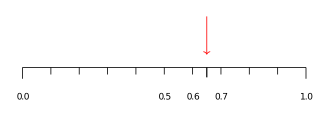
Look at the number line below. What decimal is shown by the arrow?
Which shows the correct comparison?
Which decimal is greatest?
What is the correct way to order \(0.91\), \(0.19\), \(0.99\), and \(0.11\) from greatest to least?
Compare place by place: Write \(0.6\) as \(0.60\). Now both have the same number of decimal places. Since \(60 > 59\) hundredths, we have \(0.6 > 0.59\).
When comparing decimals, look at the tenths place first---it has the most weight. \(0.35\) has \(3\) tenths; the others (\(0.53, 0.50, 0.55\)) all have \(5\) tenths. Since \(3 < 5\), the number with fewer tenths is automatically the smallest, no matter what's in the hundredths place. So \(\mathbf{0.35}\) is the smallest. \checkmark
A trailing zero doesn't change the value. Both \(0.4\) and \(0.40\) represent the same amount: \(4\) tenths, or \(40\) hundredths.
Compare the tenths place first: \(0 < 2 < 7\). For the two decimals with tenths \(= 7\), compare hundredths: \(0 < 2\), so \(0.70 < 0.72\).
The arrow points exactly halfway between \(0.6\) and \(0.7\). The midpoint is \(0.65\).
Rewrite \(0.8\) as \(0.80\) to see it clearly. Comparing: \(80 < 81\) hundredths, so \(0.8 < 0.81\).
Look at the tenths place: \(0.84\) has \(8\) tenths while the others have \(4\) tenths. Since \(8 > 4\), \(0.84\) is the largest.
Start with tenths: \(9 > 1\). Among the two with tenths \(= 9\), compare hundredths: \(9 > 1\), so \(0.99 > 0.91\). Among the two with tenths \(= 1\), compare hundredths: \(9 > 1\), so \(0.19 > 0.11\).
